

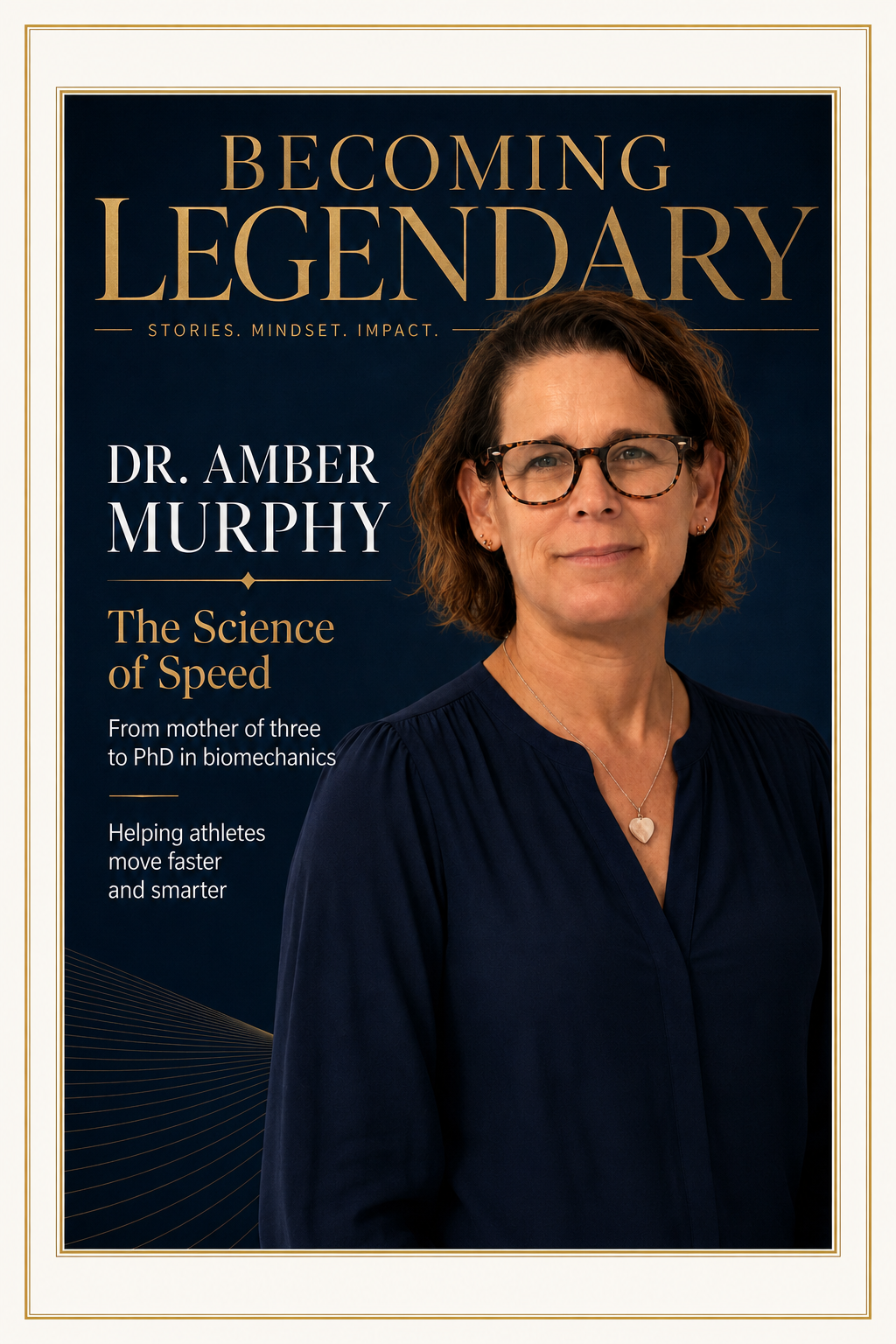
SHE DIDN’T LOOK LIKE A SCIENTIST. SO SHE BECAME ONE.
Three children. No degree at 26. Three degrees later, a PhD in her 40s — and a mission to make the science of speed understandable to everyone.
By Ana Rita Valente | The Legendary Edition
There are stories about success that begin exactly where we expect them to.
The gifted student.
The obvious prodigy.
The person whose résumé have been designed from childhood for the career they eventually built.
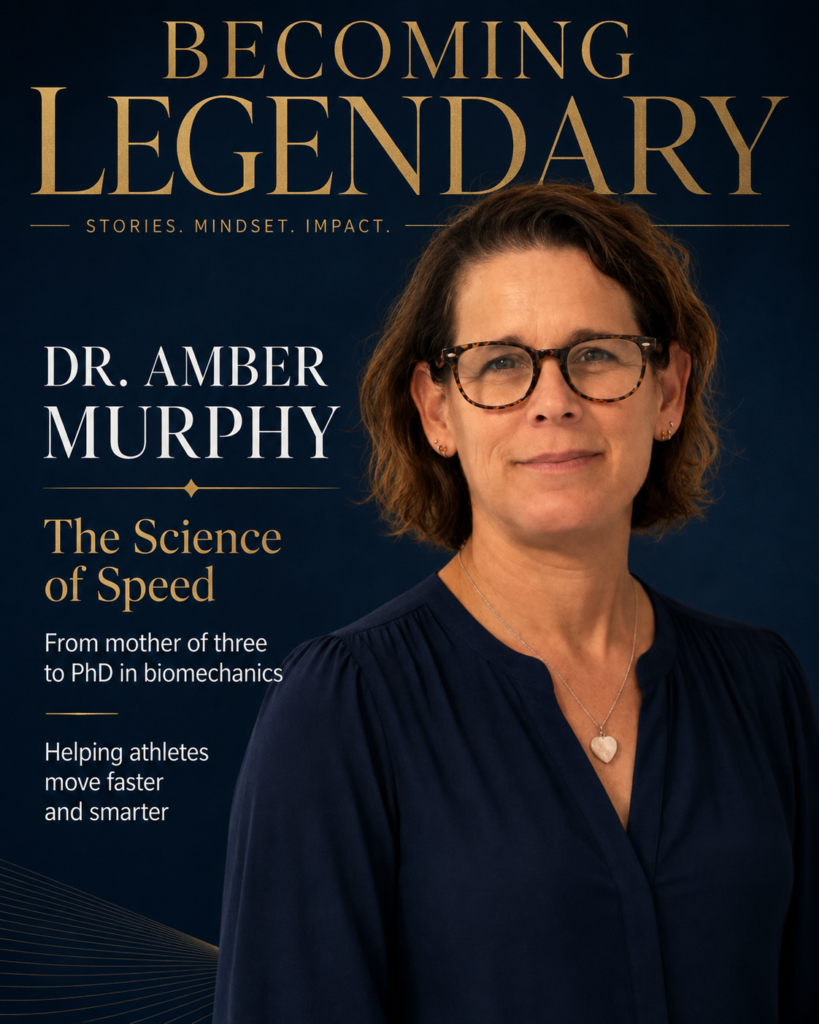
And then there are stories like Dr. Amber Murphy’s.
Those are the ones I love.
Because at 26, Amber did not have the traditional profile of somebody the world would automatically imagine becoming an expert scientist.
She had three babies and no degree.
Today, she holds a PhD, works in biomechanics, is building a company focused on helping athletes improve performance and reduce injury risk, and has written a book designed to make the science behind speed accessible beyond laboratories and elite coaching rooms.
Her story matters because there is someone reading this right now who believes they are late.
Too old.
Too busy.
Too undereducated.
Too different.
Too far behind.
Maybe they have children.
Maybe they abandoned college years ago.
Maybe they have spent half a lifetime walking into rooms where nobody expected them to belong.
Amber has a message for that person.
Your past does not dictate your future.
And she did not learn that from a motivational poster.
She lived it.
THREE BABIES. NO DEGREE. AND A DECISION.
Amber began as a collegiate athlete.
Then life moved.
By 26, she was raising three children and did not yet have a college degree.
For many people, that becomes the point at which the dream gets quietly packed away.
Not because they lack intelligence.
Because life becomes full.
Children need you.
Bills arrive.
Time disappears.
Exhaustion becomes normal.
And every year that passes can make returning to education feel more intimidating.
Amber went back anyway.
She worked.
She studied.
She raised her children.
And she continued through three degrees, eventually earning her PhD in her 40s.
I think we underestimate how important stories like this are.
We celebrate young genius constantly.
The 22-year-old founder.
The teenager who builds an app.
The person who knew exactly what they wanted at 17 and never changed direction.
Beautiful.
But life does not look like that for most people.
Some of us become ourselves slowly.
Some of us find the career after the children.
Some of us discover confidence after divorce, failure, rejection, motherhood, illness, financial disaster or simply twenty years of living.
There should be no shame in becoming later.
Amber’s life is proof that later is still becoming.
THE WOMAN WHO DIDN’T “LOOK” LIKE A SCIENTIST
Amber said something in her Becoming Legendary application that stopped me.
She explained why she believed her story belonged here:
Because although she was not educated initially and did not look like what people expected a scientist to look like, she became one — and became an expert in biomechanics.
There is an entire cultural problem hidden inside those few words.
What does a scientist look like?
Who gets assumed to be the expert?
Who walks into a room and is automatically given credibility?
And who has to earn that credibility repeatedly before anybody listens?
Amber has spent her career in a male-dominated field.
She does not pretend that was irrelevant.
She told me being a woman in her industry has absolutely created disadvantages. But something changed when she stopped trying to convince everyone.
If she goes to a track and an athlete or coach does not respect her or listen to her, she no longer feels obligated to win them over.
She knows what she brings.
She remains open to constructive criticism. She wants to improve. But she no longer believes she needs everyone’s approval in order for her expertise to be real.
That is a level of professional freedom people rarely talk about.
There is a moment in a career when you stop asking:
“How do I make them believe I belong here?”
And start asking:
“Do I even want to work with people who cannot recognize what I bring?”
Those are very different questions.
Amber has reached the second one.
WHAT DOES A BIOMECHANIST ACTUALLY DO?
Now we get to the science.
Because “sports biomechanics” can sound intimidating if you are not already living inside athletics, mathematics or human performance.
Amber describes it much more simply.
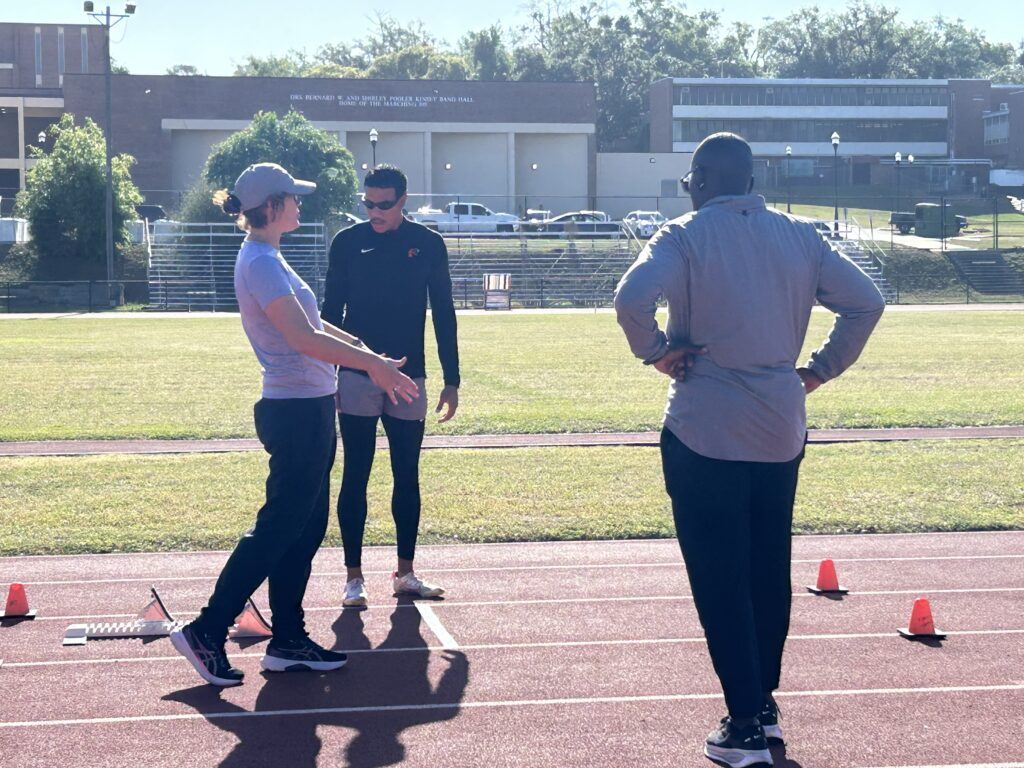
She studies movement.
She looks at variables such as ground contact time, air time, stride length and stride rate — the pieces that influence how someone moves and how fast they can move.
But the most interesting word she uses is:
Why.
Why is an athlete moving this way?
Why are they losing speed?
Why are they becoming injured?
Which movement patterns may contribute to injury?
How can performance improve without simply demanding that somebody “work harder”?
Her work centers on performance improvement and injury prevention.
That distinction is important.
Because sport often glorifies effort.
Push harder.
Run harder.
Train longer.
Ignore the pain.
But bodies are systems.
Sometimes the answer is not more effort.
Sometimes it is better movement.
Better mechanics.
Better information.
Understanding what the body is doing rather than punishing it for what it cannot do.
That is where Amber’s work becomes useful not only for elite athletes, but for ordinary people.
THE SCIENCE OF SPEED
Her objective is unusually clear.
She wants to make math and science accessible to anyone.
Not only biomechanists.
Not only professional coaches.
Not only Olympic-level athletes.
Anyone.
Amber told me that somebody who simply wants to run a little faster should be able to pick up the book, understand at least one practical concept, and use it.
And she has set herself a concrete target.
10,000 copies in a year.
Why?
Because she wants ordinary people to open a science-based book without being afraid of the science.
She wants someone to be able to say:
I understand this.
I can see something I am doing wrong.
I can make one change.
That is a surprisingly democratic way to think about expertise.
Great experts often make knowledge sound more complicated.
It protects status.
Amber wants to do the opposite.
She wants to translate expertise.
YOU DO NOT NEED TO BE AN ELITE ATHLETE
When I asked the question that probably many non-athletes would ask — Why would somebody even want to become faster? — Amber’s answer widened the entire audience for the book.
Think about a recreational runner in their 40s or 50s.
Someone doing a 5K.
A 10K.
A marathon.
They may be able to use the science to become more efficient and potentially reduce injury risk so they can keep doing what they love longer.
There is also material about hills — understanding how to move more effectively uphill and downhill.
And there are applications for parents whose children participate in team sports, including ideas around becoming faster while staying injury-free.
Suddenly, biomechanics stops being an abstract academic field.
It becomes:
How do I move?
Why does this hurt?
Why am I tiring?
What can I change?
How can my child train smarter?
How can I continue doing the sport I love without constantly breaking down?
Those questions belong to millions of people.
THE REAL SUPERPOWER: BEING UNDERESTIMATED
One theme kept returning during our conversation.
Being underestimated.
Amber understands that experience.
She has been the woman in the male-dominated room.
The person who did not match somebody else’s visual idea of a scientist.
The mother returning to education.
The woman earning a PhD in her 40s rather than following the perfectly linear academic timeline.
And somehow, being underestimated can become fuel.
Not because proving people wrong should become your entire identity.
That is exhausting.
But because eventually you realize something extraordinary:
Other people’s assumptions are not instructions.
They are just assumptions.
Amber reached a point where she no longer needs to spend all her energy correcting everybody’s perception of her.
If somebody wants to learn, she is there.
If somebody respects her expertise, there is work to do.
If they do not?
There are other tracks.
Other athletes.
Other coaches.
Other people who are ready.
That is confidence without theatrics.
THE MOTHER WHO THINKS IT IS TOO LATE
Near the end of our conversation, I asked Amber for a message to the version of herself who had three children and had not yet built the career she would eventually have.
Her answer was immediate:
“Your past doesn’t dictate your future.”
Then she went further.
Just because you look different from everybody else who wants what you want does not mean you cannot want it — and make it happen.
I want women to sit with that.
Especially mothers.
Especially women in their 40s.
Especially the woman who spent twenty years caring for everyone except herself.
Especially the woman staring at a university website thinking:
This is ridiculous. I’m too old.
No.
You are older.
That is not the same thing.
You know more now.
You have survived more now.
You probably understand discipline differently.
You understand consequences differently.
You understand time differently.
And perhaps you finally understand yourself.
Amber did not erase motherhood to become a scientist.
She did not need to pretend her life had been linear.
The motherhood, work, education, setbacks and persistence are part of the scientist she became.
THE NEXT CHAPTER
Amber is now building a biomechanics firm designed to help athletes and coaches improve performance and prevent injury, while also fighting for something broader:
making science and mathematics more accessible.
That combination interests me.
There is the technical mission.
Better performance.
Better mechanics.
Less injury.
And then there is the human mission.
Removing intimidation.
Making information usable.
Giving ordinary people access to knowledge they may assume belongs only to experts.
Her application says the dream in the simplest possible terms:
“My book reaches millions.”
I hope it does.
Not simply because selling millions of books would be impressive.
Because there is a deeper story wrapped around the book.
A mother who could have decided she was late.
A woman who could have accepted that science belonged to somebody who looked different.
A professional who could have spent her entire career trying to convince skeptical rooms to respect her.
Instead, she kept moving.
Three children.
Three degrees.
A PhD.
A company.
A book.
A mission.
That is not a story about speed.
Ironically, it is a story about refusing to confuse speed with progress.
Some lives happen quickly.
Others are built mile by mile.
What matters is that you keep moving.
YOUR PAST DOESN’T DICTATE YOUR FUTURE
If there is one idea I would take from Dr. Amber Murphy, it is not biomechanics.
It is not stride length.
It is not ground contact time.
It is this:
Your starting point is information.
It is not a sentence.
You can be 26 with three babies and no degree.
You can arrive in your 40s with a PhD.
You can enter a field where people do not expect you.
You can become the person they did not see coming.
And perhaps that is what becoming legendary actually looks like.
Not always fireworks.
Not always overnight success.
Sometimes it is getting up when nobody applauds.
Studying after the children sleep.
Returning to the classroom.
Walking into the room again.
Learning one more thing.
Building one more piece.
And one day realizing that the life people thought did not fit you—
is now yours.
DISCOVER DR. AMBER MURPHY
Dr. Amber Murphy
Sports Biomechanist • Founder • Author
CompuSport
The Science of Speed
LinkedIn — CompuSport
https://www.linkedin.com/company/compusport-llc
Instagram — CompuSport
https://www.instagram.com/compusportllc
Instagram — Dr. Amber Murphy
https://instagram.com/ambermurphy847
https://www.facebook.com/DrAmberMurphy
