


ENTREPRENEURSHIP • AI • E-COMMERCE
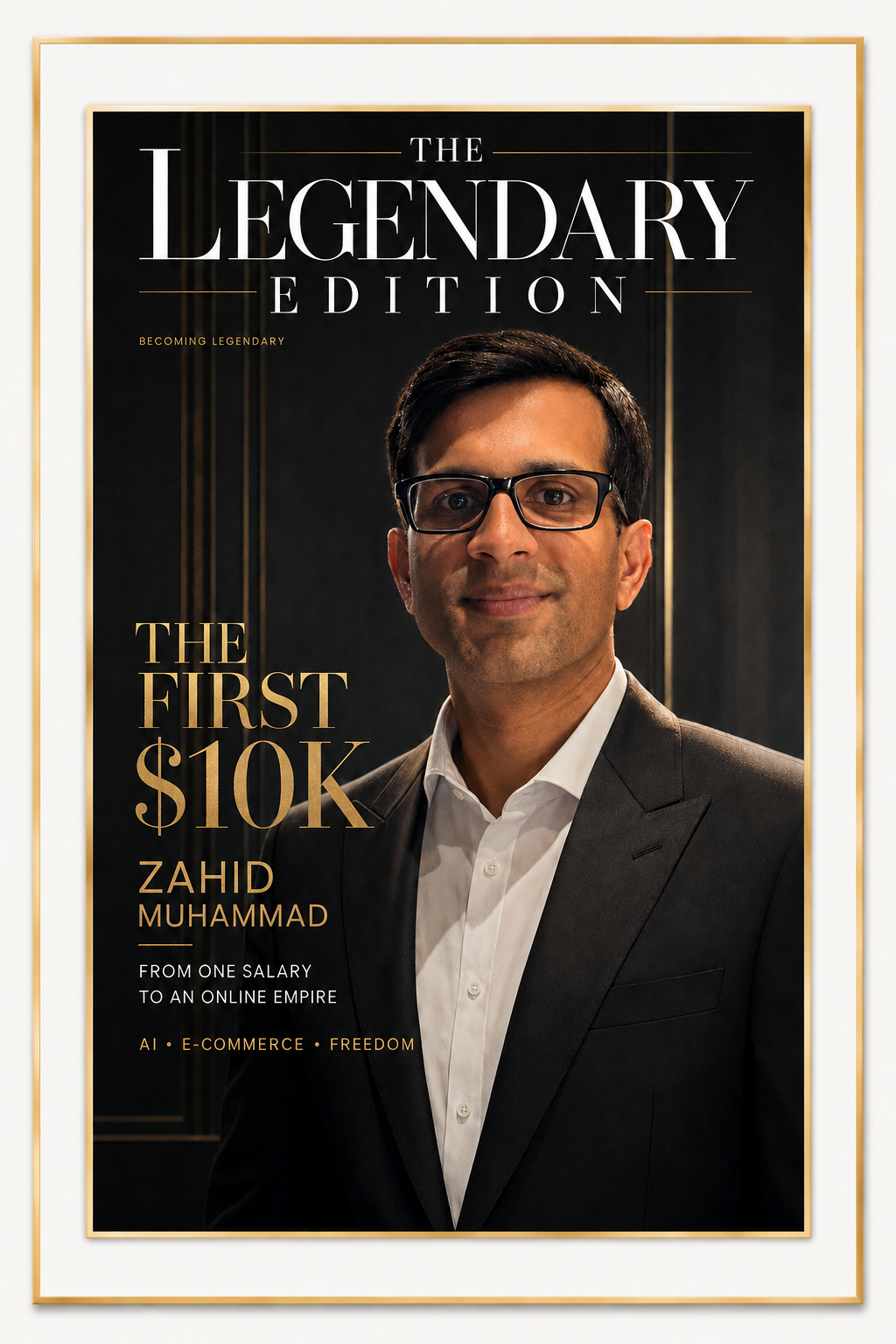
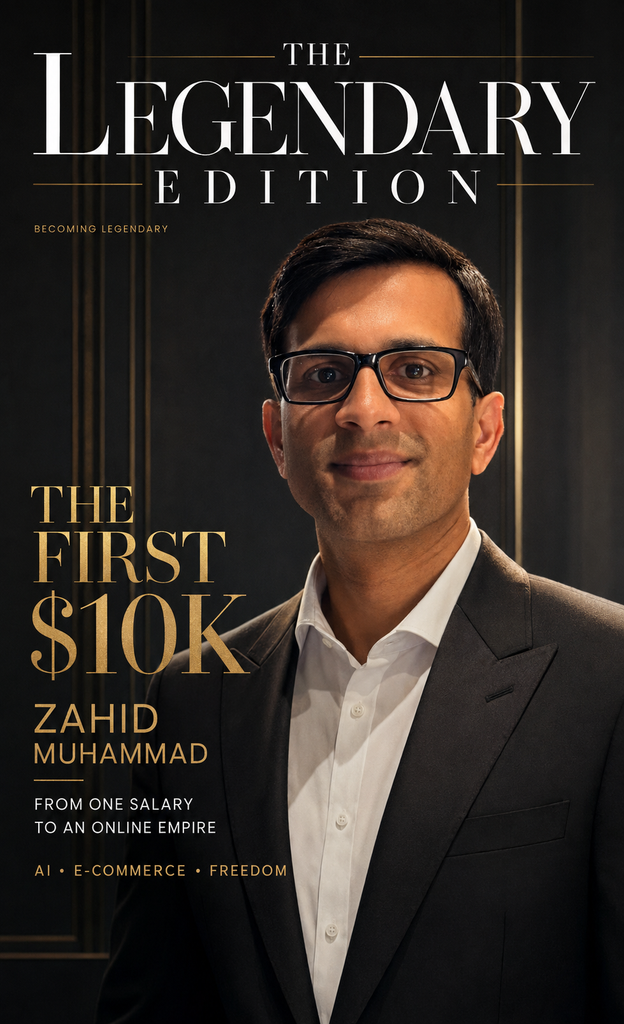
Zahid Muhammad and the First $10K: A Practical Path from One Salary to an Online Business
Through Conzia, the entrepreneur and educator is helping ordinary people turn AI, e-commerce and disciplined action into real opportunity—one achievable milestone at a time.
PROFILE BY THE WE LEGENDARY EDITION
The internet is crowded with promises of instant wealth. Scroll for long enough and someone will tell you that the right store, product or artificial-intelligence tool can make you a millionaire almost overnight. Zahid Muhammad offers a different starting point. Before the million, he says, make the first $10,000.
It is a deceptively simple idea, but it reveals the philosophy behind Zahid’s work. He does not begin with fantasy. He begins with proof: proof that a person can learn a system, select and sell a product, attract a customer and generate income beyond a monthly salary. The first $10,000 is not the destination. It is the moment an abstract ambition becomes something measurable.
“Everyone wants to make a million dollars right away,” Zahid explains. When results do not appear immediately, many people surrender before their business has had time to become a business. His alternative is a staircase: reach $10,000, learn from the process, then build toward $100,000. Only after that does the million become a meaningful target rather than an empty slogan.
This practical progression is central to Conzia, the e-commerce education and services platform Zahid is building for people who want greater financial independence. Through AI, Shopify, Amazon, dropshipping, branding, marketing and operational support, Conzia aims to make online entrepreneurship understandable to people who may never have considered themselves entrepreneurs.
For Zahid, this mission is personal. He once followed the traditional career path and had what many would describe as a good job. Yet professional security did not give him the freedom or purpose he wanted. By the end of 2018, frustration with corporate life had become impossible to ignore. He left his full-time job and began selling on Amazon.
There were mistakes, experiments and lessons before momentum arrived. Then came his first $10,000 online. From that milestone, he scaled multiple e-commerce businesses to seven figures. The achievement changed more than his income; it changed his understanding of work. A salary was no longer the only structure available. The internet could become infrastructure for building something of his own.
FREEDOM BEGINS WITH ANOTHER OPTION
Zahid’s story resonates because it begins in a familiar place: the realization that a respectable career can still feel restrictive. Many people are not trying to escape work. They are trying to escape the vulnerability of having only one source of income and one institution determining the shape of their future.
That distinction matters. Conzia’s purpose is not to encourage people to recklessly abandon their jobs. It is to help them develop another option. A person can start by learning, testing a niche, understanding customers and building an online asset alongside existing responsibilities. Entrepreneurship becomes less intimidating when it is treated as a sequence of practical decisions rather than a dramatic leap into the unknown.
Zahid is building Conzia as a global platform for exactly that transition. In his application to Becoming Legendary, he describes his goal as helping ordinary people use AI and e-commerce to create additional income and become less dependent on a single job or salary. His focus is accessibility: taking tools that sound complicated and translating them into systems people can understand and implement.
That may be his greatest relevance at this moment. AI is discussed everywhere, but conversation does not automatically create opportunity. People hear that the technology is transforming business, while many still do not know what to do with it on Monday morning. Zahid wants to close that gap. The question is not whether AI is impressive. The question is whether it can help someone research a product, understand a customer, produce better marketing, automate repetitive work or make a small online business more competitive.
THE NEW E-COMMERCE TOOLKIT
The modern online seller has more options than the entrepreneurs who entered e-commerce twenty years ago. Amazon FBA can provide access to a vast marketplace and fulfillment network. Shopify allows founders to build a branded direct-to-consumer store. Dropshipping can reduce the need to purchase and warehouse inventory before demand is proven. AI can accelerate research, content development, customer analysis and everyday operations.
None of these tools is a magic button. Each requires judgment. A store needs a coherent niche, credible design, useful product presentation, customer service and a realistic marketing plan. A founder must understand margins, competition, fulfillment and the expectations of the people they hope to serve. Technology can shorten certain tasks, but it does not eliminate responsibility.
This is where Zahid’s experience as an entrepreneur, educator, consultant and agency leader intersects. Conzia does not focus on only one isolated moment, such as launching a storefront. Its services span store development and revamping, branding, product creatives, web development, social-media marketing, daily store management, custom development, audits and consultancy. The company says it has assisted more than 1,000 entrepreneurs across Shopify and Amazon.
The model recognizes a truth that many new sellers learn painfully: opening a store is easy compared with operating one well. The real work begins after launch. Product pages must earn trust. Advertising must be tested. Data must be interpreted. Creatives need to capture attention without misleading the customer. Delivery and service must support the promises made in marketing.
Conzia’s approach is therefore both educational and operational. Some people want to learn how to build independently. Others need specialists to help with design, marketing or management. Zahid sees value in supporting both.
FREE KNOWLEDGE BEFORE THE SALE
One of the most revealing parts of Zahid’s philosophy is his commitment to giving people a place to learn before they buy. Conzia publishes tutorials and educational material through its YouTube channel. Zahid also describes a network of 16 Meetup groups with approximately 8,500 members and three sessions each week. The Meetups, he emphasizes, are free.
This creates a low-pressure first step for people who are curious but not yet ready to invest in a course or service. They can listen, ask questions and begin separating the mechanics of e-commerce from the mythology surrounding it. According to Zahid, the majority may continue using the free resources, while a smaller percentage eventually hires Conzia. That minority allows the broader educational ecosystem to remain open.
It is a model built on trust rather than information scarcity. In an industry where basic knowledge is often hidden behind aggressive funnels, Zahid is comfortable placing useful material in public. Conzia’s course database expands that educational structure with approximately 100 short lessons supported by multiple coaches. The videos are designed to be digestible—often five, six or ten minutes—so learners can progress through specific actions rather than confronting an overwhelming wall of theory.
The principle is simple: people do not necessarily need more motivation. They need clarity about the next action.
WHY THE FIRST $10,000 CHANGES EVERYTHING
The first-$10K framework is powerful because it gives aspiring founders a target large enough to matter and small enough to visualize. It also forces attention onto the fundamentals. To reach it, someone must move beyond collecting ideas. They must make offers, observe customer behavior, solve problems and adjust.
The milestone can also change a person’s identity. Before the first sale, they are preparing to become an entrepreneur. After repeated sales, they are operating a business. Revenue alone does not guarantee profit, sustainability or long-term success, but it provides evidence that a market exists and that the founder can participate in it.
Zahid’s framework does not erase risk. Conzia explicitly states that it does not guarantee specific sales, profits or results. Outcomes depend on the product, pricing, service, niche, advertising budget, competition, market conditions and the decisions of each business owner. That transparency is important. E-commerce should be approached as a real enterprise, not a lottery ticket.
What Conzia can provide is a system, education, technical support and experience. The entrepreneur must still bring effort, patience and accountability. In that partnership lies a far more credible promise than overnight wealth: the possibility of becoming capable.
DROPSHIPPING BEYOND THE OLD STEREOTYPE
Dropshipping is frequently reduced to a caricature—a low-quality product copied from a supplier and placed into a generic storefront. Zahid argues that the fulfillment model is much broader than that stereotype. At its core, dropshipping simply means a retailer sells a product without keeping that inventory in its own warehouse; the supplier fulfills the order directly.
The model can be used carelessly, but it can also be used to test demand, expand a catalog and build sophisticated retail operations. What determines the quality of the business is not the word “dropshipping.” It is the quality of the products, suppliers, branding, customer experience and management behind it.
New sellers can now connect stores with a wide range of supplier platforms and applications. The abundance of options makes entry easier, but it also increases the need for discernment. A viable product must satisfy more than personal enthusiasm. It needs demand, workable economics and a reason for customers to choose that store rather than hundreds of alternatives.
This is another reason Zahid stresses learning before scaling. Advertising cannot rescue a weak offer forever. AI cannot manufacture customer trust from nothing. Sustainable growth is built when technology supports sound commercial thinking.
MAKING AI USEFUL TO ORDINARY PEOPLE
Zahid’s work sits at the meeting point of two forces: the democratization of e-commerce and the rapid adoption of AI. Together, they can give small sellers capabilities that once belonged primarily to larger companies. A founder can analyze markets, generate drafts, explore branding directions, organize product information and improve workflows with relatively accessible tools.
But access is not the same as mastery. People can lose days moving between applications without building anything. Zahid’s educational role is to turn possibility into a process: identify the business goal first, then choose the technology that advances it.
That orientation protects entrepreneurs from becoming distracted by every new platform. The objective is not to look technologically advanced. It is to understand customers and run a stronger business. AI is most useful when it reduces friction between a founder and a meaningful action.
For someone beginning today, that might mean using AI to organize niche research, compare customer frustrations or develop several versions of a product description for testing. Later, it might support content production, customer-service workflows and marketing analysis. At every stage, the human founder remains responsible for verification, ethics and decisions.
A GLOBAL MOVEMENT BUILT AROUND PRACTICAL INDEPENDENCE
Conzia operates with a global perspective, with a presence connected to Miami and Berlin and an audience that extends far beyond either city. Its larger opportunity is not simply to create more online stores. It is to create more people who understand how digital commerce works—and who can use that knowledge to build resilience.
That mission is especially relevant for professionals who feel trapped, parents who need flexible possibilities, immigrants rebuilding in a new country, and ambitious people whose geography once limited their access to markets. An online business does not remove every barrier, but it can create a door where none existed before.
Zahid is not asking everyone to follow one identical route. Amazon, Shopify, FBA, dropshipping, AI services and other online-income models can each be appropriate under different circumstances. The deeper lesson is to stop treating financial freedom as one impossible jump. Build competence. Create the first offer. Earn the first sale. Reach the first $10,000. Learn what the market is teaching you. Then scale what deserves to grow.
This is how Zahid Muhammad reframes the dream of becoming rich. Wealth begins not with a viral promise but with the first credible proof that you can create value independently. The number matters, but the transformation behind it matters more.
The employee who once felt restricted by a traditional path became an entrepreneur who built seven-figure businesses. Now, through Conzia, he is working to make that path more visible and more understandable for others. He is not offering a shortcut around the work. He is offering a map through it.
And for the person staring at the distance between one salary and one million dollars, the map begins with a far more useful question:
How will you build your first $10K?
DISCOVER ZAHID MUHAMMAD AND CONZIA
Explore Conzia’s e-commerce services and free discovery call, learn through the Conzia YouTube channel, follow Conzia on Instagram, or connect directly with Zahid Muhammad on LinkedIn.
Editorial note: E-commerce involves risk, and individual outcomes vary. Revenue examples and client results are not guarantees of future sales or profit. Readers should conduct their own research and obtain appropriate legal, tax or financial guidance before making business decisions.
ROCKY VALENTE
ahid Muhammad
Founder & CEO at Conzia
Conzia Inc. 2125 Biscayne Blvd,
Ste 204, Miami, Florida 33137 USA
Our WhatsApp

Legal Disclaimer:
Conzia Inc. provides marketing, consulting, and e-commerce support services. We are committed to honesty and transparency.
However, it is important that all Clients understand the following:
1. No Guaranteed Results: Conzia Inc. does not guarantee any specific sales, revenue, profit, or results from our services. Any figures, case studies, or testimonials we share (including sales screenshots, growth percentages, or client success stories) are illustrative examples only. They represent exceptional outcomes achieved under unique circumstances and are not typical.
2. Individual Results Vary: The success of any online business depends on many factors beyond our control, including the Client’s products, pricing, customer service, niche selection, ad budget, competition, and market conditions. For this reason, outcomes will differ for each Client.
3. Testimonials and Case Studies: Any testimonials or case studies used on our website, in presentations, or in marketing materials reflect the personal experiences of individual clients. They are not intended to represent or guarantee that any other person will achieve the same or similar results.
4. Not a Business Opportunity or Investment: Conzia Inc. does not sell business opportunities, franchises, or investment schemes. We provide marketing and support services only. Nothing on our website, in our materials, or in discussions should be construed as a promise of financial gain or employment.
5. Client Responsibility: Clients remain fully responsible for their business decisions, compliance with applicable laws, customer service, and fulfillment of orders. By engaging our services, Clients acknowledge and accept the risks inherent in operating an online business.
6. No Legal, Financial, or Tax Advice: Conzia Inc. does not provide legal, financial, or tax advice. Clients should consult with qualified professionals before making business, tax, or legal decisions.
7. Limitation of Liability: To the maximum extent permitted by law, Conzia Inc. shall not be held liable for any losses, damages, or claims arising from the use of our services, including but not limited to lost profits, business interruptions, or reputational harm.
8. This email, including any hypothetical scenarios described, is for informational and illustrative purposes only and does not constitute professional advice. All scenarios are hypothetical and not indicative of any specific results or past performance. Outcomes will vary based on individual efforts, decisions, and external factors. No guarantees or promises are made regarding success, earnings, or results. Individual achievements depend on personal abilities, market conditions, and other variables. Conzia assumes no responsibility for actions taken based on this content. Always consult qualified professionals before making significant business or financial decisions.
