


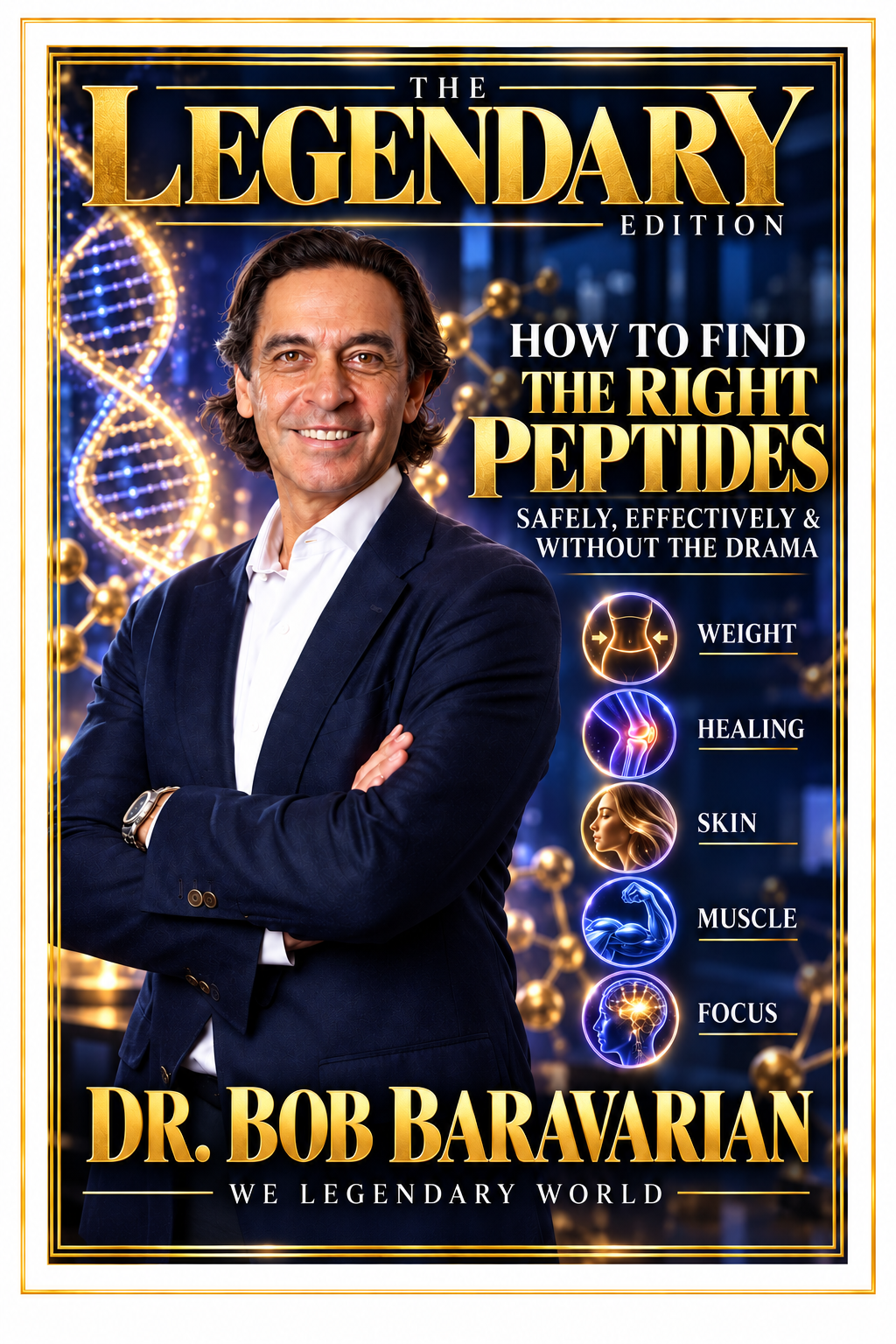
After 25 years in medicine, Dr. Bob Baravarian entered one of health’s most talked-about—and most confusing—new frontiers. His mission is not to tell everyone to take peptides. It is to help people understand why they are interested, what questions they must ask, and how to seek qualified guidance before choosing anything.
By Rocky Valente | The Legendary Edition
Some interviews begin with pages of research and carefully prepared questions. Others begin with the pleasure of admitting that I have something completely new to learn.
My conversation with Dr. Bob Baravarian belonged to the second kind.
I had heard the word peptides everywhere. People spoke about them in connection with weight loss, recovery, inflammation, hair, skin, muscle, energy, anxiety, concentration and longevity. Every conversation seemed to introduce another name and another possibility.
There was only one problem: I still did not know what a peptide was, where someone should begin, or how an ordinary person could separate responsible medical guidance from confident noise on the internet.
So I told Dr. Bob the truth. I could barely pronounce the word. I asked him to explain peptides as if I were five.
That simple request became the heart of our conversation—and, ultimately, the clearest expression of his mission: how to find the right peptides safely, effectively and without the drama.
Dr. Bob is not entering this field as a social-media personality chasing the latest wellness trend. He is a physician with approximately 25 years of experience, a foot and ankle surgeon, a former college athlete, an entrepreneur and the founder of Alpha Bioscience Labs.
He came to peptides first as a curious patient. What he experienced led him to investigate the science, the products, the quality problems and the gaps in guidance. What he discovered convinced him that people did not simply need access to peptides. They needed education, transparency, professional oversight and a much clearer way to decide what—if anything—was appropriate for them.
That distinction matters.
Peptides are not one product with one purpose. The word describes a broad category of short chains of amino acids that can act as signals in the body. Different compounds have different mechanisms, evidence, regulatory status, risks and possible uses. Some peptide-related medicines have established approved applications. Others are investigational, compounded, used off-label, or promoted with claims that move faster than the evidence.
This is why the real question is not simply, “Do peptides work?”
The better questions are: Which peptide? For what purpose? Based on what evidence? From what source? Under whose supervision? With what testing, monitoring and understanding of the risks?
That is the conversation Dr. Bob wants more people to have.
________________
FIVE REASONS PEOPLE ARE ASKING ABOUT PEPTIDES
After our interview, Dr. Bob clarified the five subjects people ask about most often. Together, they show why the category is attracting so much attention—and why a single viral recommendation can never replace an individualized medical discussion.
1. WEIGHT MANAGEMENT
The best-known peptide-related conversation today involves GLP-1–based medications used for diabetes and chronic weight management under specific medical indications. Their visibility has introduced millions of people to the language of peptides.
But popularity can make a medical decision look deceptively simple. A person’s health history, current medications, goals, contraindications, possible adverse effects, access to follow-up care and the legitimacy of the product all matter.
The lesson is not that everyone should pursue the same treatment. It is that successful weight management deserves a plan rather than an impulse.
2. INFLAMMATION, RECOVERY AND TISSUE REPAIR
Dr. Bob identified BPC-157, TB-500, GHK-Cu and KPV as compounds frequently discussed in connection with inflammation reduction and tissue repair.
These names are popular in athletic, recovery and longevity communities, but they should not be treated as interchangeable or automatically appropriate. The quality and strength of human evidence vary, and some uses remain investigational or are not approved by major regulators.
Someone recovering from pain or injury may be especially vulnerable to dramatic promises. The responsible approach begins with understanding the underlying condition, obtaining a proper diagnosis and discussing the evidence and uncertainties with a qualified clinician.
3. HAIR AND SKIN
GHK-Cu, often called a copper peptide, is widely discussed in relation to collagen, skin quality and hair. It also appears in topical cosmetic conversations, making it one of the more recognizable names for people entering the peptide world through aesthetics rather than medicine or athletic performance.
The desire is easy to understand. People want healthier skin, stronger hair and support for the changes they notice with age. But route of administration, formulation, product quality and evidence all matter. “Copper peptide” on a label does not automatically answer whether a product is legitimate, effective or suitable for a particular person.
4. MUSCLE, RECOVERY AND BODY COMPOSITION
Dr. Bob also highlighted tesamorelin, ipamorelin, CJC-related compounds and sermorelin, which are discussed in relation to growth-hormone pathways, muscle development, recovery and visceral fat.
This category can be particularly confusing because medically established uses may sit beside compounded or investigational uses, while online discussions often collapse them into one promise. More is not automatically better, and changing a hormonal pathway is not something to approach casually.
Goals, laboratory data, medical history and monitoring belong in the conversation. So do realistic expectations about training, nutrition, sleep and the limits of any intervention.
5. ANXIETY, FOCUS AND COGNITIVE FUNCTION
Selank and Semax are often discussed in relation to anxiety, concentration and cognitive performance. Interest in these compounds reflects a much larger reality: many people are looking for help with stress, mental fatigue and the ability to focus.
Those concerns deserve to be taken seriously. They also deserve an appropriate clinical assessment. Anxiety and cognitive changes can arise from many causes, and an emerging peptide should not become a substitute for diagnosing what is happening or receiving established mental-health or neurological care when needed.
Across all five categories, the pattern is the same. People are not searching for a chemistry lesson. They are searching for an outcome: less weight, less pain, better recovery, healthier skin, more muscle, calmer thinking or sharper focus.
Dr. Bob’s work begins by translating that desired outcome into better questions.
________________
FROM COLLEGE ATHLETE TO PATIENT
Long before Alpha Bioscience Labs, Dr. Bob was an athlete. He played college sports, still plays tennis and continues to exercise. As he aged, however, recovery began to feel different. He described waking up sore and tired—almost like a robot trying to get out of bed.
Around two years before our conversation, he began exploring peptides for himself. He reported improvements he associated with their use, including reduced inflammation, improved body composition, better skin and the return of some muscle.
Those are his personal observations. They are not a guarantee that another person will experience the same effects, and personal experience does not establish general medical evidence.
For Dr. Bob, however, the experience was powerful enough to create a new question: if these compounds were attracting so much interest, why was the market so difficult to understand?
He began researching products, sourcing, testing and the ways peptides were being presented to the public. The deeper he looked, the more concerned he became about what he describes as a gray and fragmented market.
People could find persuasive promises. What they could not always find was clear information about where a product came from, what it contained, how it had been tested, who was guiding its use or what happened after the purchase.
That gap became the foundation of his next business.
________________
THE PROBLEM WASN’T INTEREST. IT WAS TRUST.
Dr. Bob founded Alpha Bioscience Labs around a simple idea: people should be able to ask questions and inspect information rather than accept reassuring language at face value.
According to his description, the company’s model emphasizes U.S. manufacturing, licensed and certified pharmacy partners, independent third-party laboratory testing, transparency through QR codes and access to physician-supported guidance.
He said products are tested for sterility, endotoxins and contents, with testing information made accessible through a QR code on the bottle. These are processes Dr. Bob described in our conversation; this editorial feature does not independently certify individual products, reports or facilities.
The QR code interested me because it makes the promise of transparency tangible. A customer can ask to see information instead of being told simply to trust the seller.
But a laboratory report is only one part of a responsible decision. A report may provide information about a product’s contents or quality; it does not by itself prove that a compound is effective, approved, risk-free or appropriate for a particular person.
Trust in health must include both transparency and limits.
________________
THE RIGHT PEPTIDE MAY ALSO BE NO PEPTIDE
One of the most important ideas in this conversation is also the least dramatic: the correct answer will not be the same for everyone.
A responsible process begins before a product is selected. What is the person trying to change? Is there an established diagnosis? What treatments have already been tried? What medications are they taking? What do their laboratory results show? What evidence supports the proposed option? What are the known and unknown risks? Who will monitor progress and respond if something goes wrong?
Sometimes the outcome of that discussion may be a particular treatment. Sometimes it may be a different treatment, further testing, changes in lifestyle, a referral to another specialist—or no peptide at all.
That is not a failure of the process. That is the process working.
Dr. Bob described a telehealth pathway designed to connect people with professionals familiar with this field. He also spoke about physicians from different specialties contributing to decisions and follow-up intended to review progress and consider adjustments.
The pathway he shared was:
ABS Health — Telehealth
https://abs-health.com/intro
What interested me was not merely the possibility of obtaining a product. It was the possibility of having somewhere to take the questions.
________________
PEPTIDE RX PRO: TURNING CONFUSION INTO BETTER QUESTIONS
My entrepreneurial curiosity sharpened when Dr. Bob introduced Peptide RX Pro, a platform he described as being close to launch at the time of our interview.
He said users would be able to enter information about symptoms, medications and laboratory results and receive a report intended to help organize that information and identify options or questions to discuss further.
The address he shared was:
https://PeptideRxPro.com
Dr. Bob emphasized that using the platform would not necessarily require purchasing products from Alpha Bioscience Labs. He wanted people to have access to information even if they selected another provider or did not buy from his company.
That principle has potential, provided the limits remain clear. A technology-generated report should not be confused with a diagnosis, a prescription or individualized medical judgment. Users need to understand how information is generated, what evidence is used, how recommendations are reviewed, how personal data is handled and when a qualified clinician must become involved.
Used responsibly, a tool like this could help someone arrive at a professional conversation better prepared. It could give people language for the questions they did not know how to ask.
________________
THE DOCTOR BECOMES THE STUDENT AGAIN
One of the qualities I most value in accomplished people is their willingness to become beginners again.
After approximately 25 years as a foot and ankle surgeon, Dr. Bob could have remained comfortably inside a career he had already mastered. He had cared for patients over decades, developed products and techniques, taught internationally and built a professional life of which he was proud.
Instead, he encountered a new field and allowed himself to become curious.
He described researching manufacturing and testing, seeking advice and assembling a team. He spoke about his partner Paul, whom he calls “the professor,” and about bringing physicians together to contribute within their specialties.
His own role is to coordinate those pieces—to bring medical experience, entrepreneurial drive and the right experts into the same room.
His guiding principle is: “The way you do anything is the way you do everything.”
That sentence helped me understand the name Alpha. Dr. Bob is competitive. He wants to operate at the highest level. My own version is simple: I do not get on the field if it is not to win.
But in medicine, winning cannot mean making the loudest promise. It must mean building systems that can withstand questions.
________________
AGING WITHOUT SURRENDER—OR MAGICAL THINKING
Our conversation became personal, as my conversations often do.
I spoke about changes in my own body: sleep, weight, energy, perimenopause and the frustration of wanting to understand what was happening rather than simply being told to accept feeling different.
Dr. Bob spoke about seeing his wife and sister experience menopause and how that drew his attention to the difficulty women can face in finding coherent support.
I valued the space to ask basic questions without pretending I already knew the answers. Many people arrive at health conversations carrying uncertainty, embarrassment or the feeling that their concerns have been dismissed. Being heard is an important beginning.
But it is a beginning, not a prescription.
Aging without surrender does not mean believing every new promise. It means refusing to abandon curiosity while remaining willing to examine evidence, risks and alternatives. It means becoming an active participant in our health without pretending that enthusiasm is the same thing as certainty.
That balance—possibility without magical thinking—is where this conversation became most valuable to me.
________________
A BUSINESS, A MISSION AND A RESPONSIBILITY
When I asked about his vision, Dr. Bob returned repeatedly to education.
He wants people to understand what peptides are, why different compounds are discussed, how products are sourced and tested, and why professional guidance matters. He hopes others may experience improvements like those he associates with his own journey, while recognizing that each compound and each person must be considered individually.
He was candid about the work behind the vision: licensing, pharmacies, telehealth, distributors, products, technology and recruiting the right team.
A business in an emerging health field must keep learning as evidence and regulations evolve. Education is only useful when it explains uncertainty as clearly as possibility.
That is why his most powerful message is not a list of peptide names.
It is a method:
Know what you want to address.
Understand what is—and is not—known.
Verify the source and testing.
Seek appropriately licensed medical guidance.
Review your medications, health history and laboratory information.
Create a monitoring and follow-up plan.
Be willing to hear that the right choice may be different from the one you expected.
That is how people find the right peptides safely, effectively and without the drama.
________________
WHY I THINK DR. BOB IS LEGENDARY
What drew me to Dr. Bob was not simply the company he is building. It was the person behind it: an athlete, surgeon and entrepreneur who continues to look for ways to learn and contribute.
I was moved by the story of his father, who noticed that he had good hands and cared about people and encouraged him toward medicine. As a young athlete, Dr. Bob imagined a future in tennis. Spending time with the doctor who cared for his team introduced him to another possibility.
When I asked what he would tell his younger self, he challenged the familiar advice to “do what you love.” His point was that young people do not always know what they will come to love. We need room to discover it.
Had he followed only the dream he understood then, he said, he might have missed becoming a doctor and helping people.
The same pattern appears across his entrepreneurial work. Whether developing medical techniques, creating ArchTek arch-support socks or building Alpha Bioscience Labs, he sees a problem and asks what he can create from it.
For me, being legendary means using what we learn to contribute something worthwhile—and remaining willing to evolve after the world assumes we have already arrived.
Dr. Bob has begun another demanding chapter in a field filled with excitement, uncertainty and enormous responsibility. His story deserves attention because he is willing to become a student again and because his stated mission begins with a question people urgently need help answering:
How do I find the right peptide—safely, effectively and without the drama?
________________
CONNECT WITH DR. BOB BARAVARIAN
Alpha Bioscience Labs
Founded by Dr. Bob Baravarian, Alpha Bioscience Labs is the peptide company he described during our conversation, built around U.S. manufacturing, independent third-party testing, transparency, education and physician-supported care.
https://www.instagram.com/alphabioscience
Peptide RX Pro
The platform Dr. Bob described for helping users organize information concerning symptoms, medications and laboratory data and identify questions to explore with a qualified professional. Availability and current functionality should be confirmed directly with the team.
ABS Health — Telehealth
The telehealth pathway Dr. Bob shared for people interested in speaking with an appropriately licensed professional familiar with the peptide field.
Discover We Legendary
https://linktr.ee/welegendary.world
________________
EDITORIAL AND MEDICAL NOTE
This feature reflects Dr. Bob Baravarian’s views, descriptions and personal experiences shared during his conversation with Rocky Valente and in subsequent correspondence. It is editorial content for general educational purposes and is not medical advice, diagnosis, treatment guidance or an endorsement of any specific product.
Peptides differ significantly in evidence, regulatory status, approved uses, quality standards, risks and suitability. Several compounds discussed in public peptide communities may be investigational, compounded, used off-label or not approved for the promoted purpose. Personal experiences and laboratory reports concerning product contents do not establish safety or effectiveness for an individual.
Readers should consult an appropriately licensed healthcare professional who can review their medical history, medications, goals, laboratory information and available evidence before beginning, stopping or changing any treatment. Anyone experiencing urgent or severe symptoms should seek immediate medical care.
