


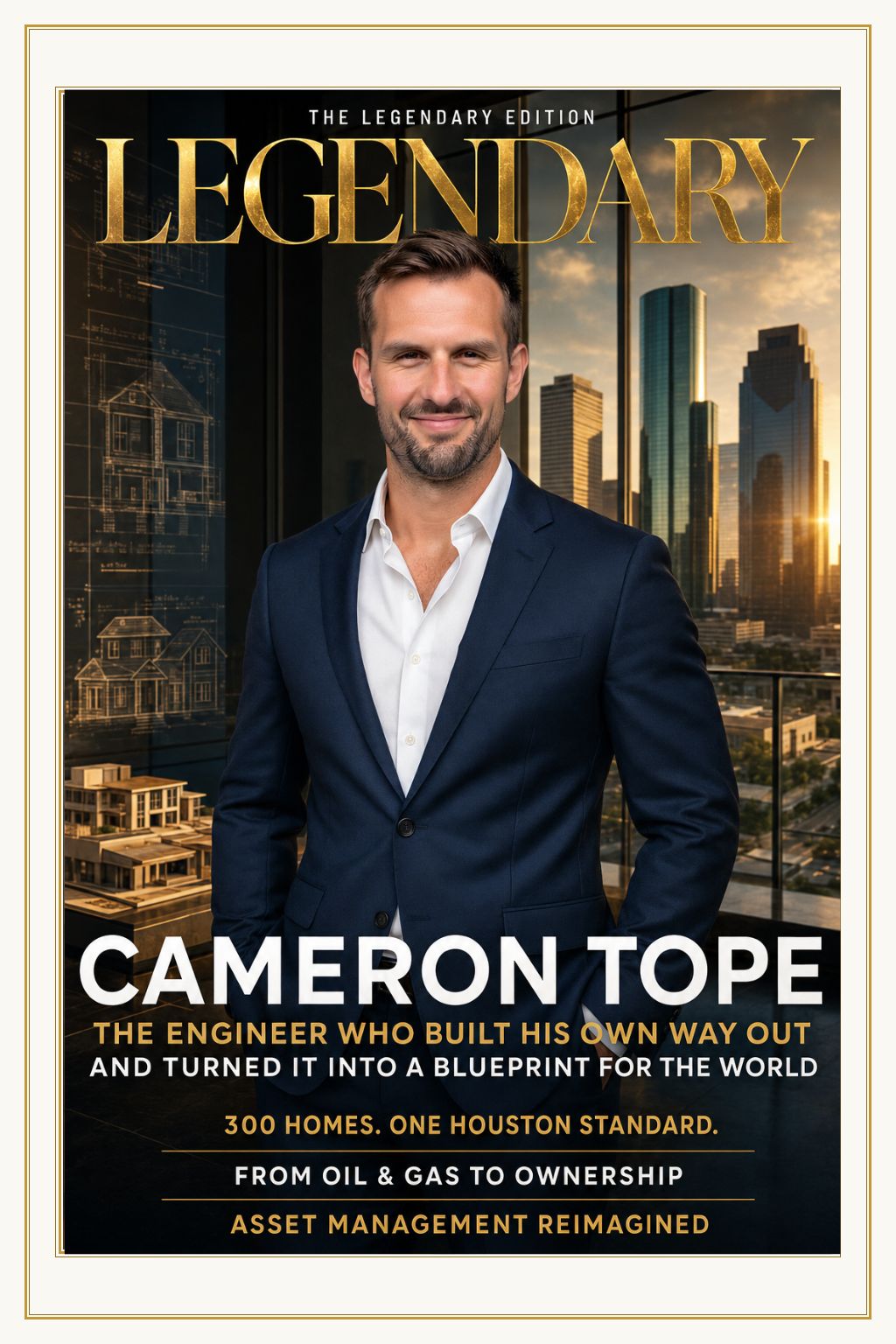
FOUNDER PROFILE
THE ENGINEER WHO BUILT HIS OWN WAY OUT—AND TURNED IT INTO A BLUEPRINT FOR THE WORLD
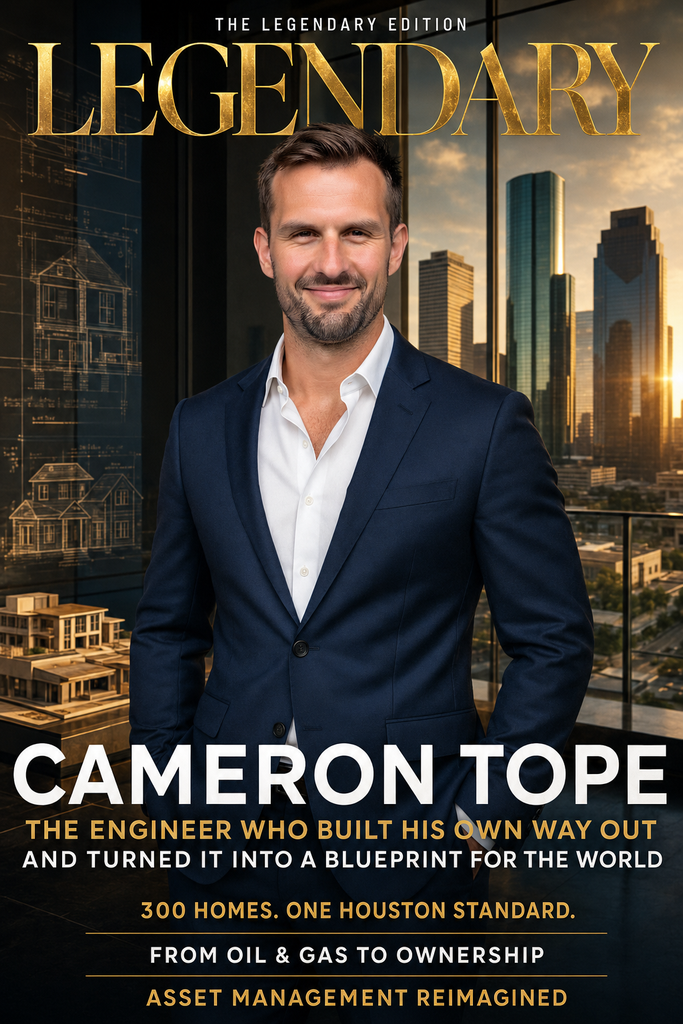
How Cameron Tope refused to become a victim of uncertainty, engineered his own freedom, and transformed a personal solution into a system helping others build more secure futures
By Rocky Valente | The Legendary Edition
There is a particular kind of confidence that does not announce itself loudly. It shows up in the way someone answers a difficult question without decoration. Ask Cameron Tope why he built Emerson Property Management and he does not reach for a grand origin myth. He gives the practical answer first: he needed a property manager he could trust, and he could not find one.
That answer contains the blueprint for everything that followed.
Before Cameron was the founder and CEO of a company managing approximately 300 single-family rentals across Greater Houston, he was a petroleum engineer working in oil and gas. The career looked stable from the outside. Inside the industry, however, stability could disappear with the price of a barrel. Early in his career, Cameron watched oil prices collapse and layoffs move through the business. He noticed something important about the more experienced people around him: some were worried, but those who had built assets outside their salaries were not facing uncertainty in the same way.
Real estate became Cameron’s answer to a question many professionals avoid until a crisis forces it upon them: What happens when the job you worked so hard to earn can no longer promise the life you expected?
He began buying Houston single-family rentals in 2013. This was not a social-media reinvention or an overnight escape from employment. It was a disciplined attempt to create options. Over time, his portfolio grew beyond 30 doors. During one particularly active year, he was acquiring roughly one property every six weeks. Each acquisition brought him closer to financial independence, but it also exposed a new problem. Owning rentals and protecting their performance were two very different jobs.
The company he needed did not exist
Cameron tried hiring property managers. What he wanted was not extravagant: professional oversight, transparent fees, clear communication and decisions made with the long-term value of the property in mind. What he encountered too often were unanswered questions, inflated maintenance costs, inconsistent standards and managers who treated the home as another address in a database.
For an investor risking his own capital, that gap was impossible to ignore.
So Cameron began managing the properties himself. The decision placed him inside every part of the operation: tenant selection, leasing, pricing, maintenance, vendor management, documentation, rent collection, legal compliance and owner communication. He learned property management from the least forgiving position possible–as the person who would personally absorb the cost of every weak decision.
Friends, relatives and fellow investors noticed the difference. They began asking Cameron to manage their properties too. The solution he had created for himself gradually became a service for a small circle of owners. In 2019, it became Emerson Property Management.
The company grew primarily through referrals, but the deeper story is not simply that Cameron discovered a business opportunity. He discovered that the frustration of being a customer can become a powerful operational advantage. He knew what owners feared because he had experienced it. He knew what they wanted to see in a monthly statement, what they needed to hear when something went wrong and why an apparently inexpensive shortcut could become a devastating bill months later.
He was not designing a company from the manager’s side of the desk. He was building it from the owner’s side.
A property is an asset, not a list of tasks
The distinction at the center of Emerson is deceptively simple: property management is not the same as asset management.
A rent-collection company can complete tasks. It can receive payments, send notices and dispatch a contractor when something breaks. An asset manager asks a larger question: Is every decision protecting the property’s income, reducing downside risk and improving its long-term performance?
That question changes everything. Tenant selection is not merely about filling a vacancy; it is about balancing leasing speed with the probability of a stable tenancy. Rent pricing is not a contest to publish the highest possible number; it requires understanding what the market will support and what prolonged vacancy will cost. Maintenance is not just the coordination of repairs; it is quality control, vendor accountability and the prevention of recurring failures. Communication is not a courtesy added after the operational work; it is part of how an owner understands risk and makes better decisions.
Cameron describes property management as a business with a long feedback loop. A compromised screening decision may look harmless on move-in day. Deferred maintenance can make one month’s statement look better. But six or twelve months later, the consequences may appear as an eviction, major property damage or a five-figure renovation. By the time the mistake is obvious, the person who made it may no longer remember the small decision that created it.
This is why Emerson’s model is built around repeatable standards rather than improvisation. Prospective vendors begin with smaller test jobs before receiving larger assignments. Resident feedback after maintenance work creates an accountability record that goes beyond a contractor’s references. Screening criteria are documented. Property conditions are recorded. Performance is measured. The objective is not to eliminate every surprise–an impossible promise in real estate–but to prevent avoidable surprises from becoming the owner’s normal experience.
Technology supports that discipline. Emerson uses systems that help triage maintenance requests quickly, organize communication and give team members access to established knowledge. But Cameron does not treat technology or artificial intelligence as magic. A tool can accelerate a good process; it cannot rescue a process that was never clearly designed.
Accountability that an owner can test
Trust is one of the most overused words in business. Emerson attempts to make it visible.
The company uses flat-fee pricing designed to reduce the possibility that advice is influenced by extra transactions or a higher rental rate. Management agreements are month-to-month, with no onboarding or exit fees. New owners receive a 90-day risk-free trial. A 30-day lease guarantee places a consequence on Emerson if a qualifying property is not leased within the promised period.
These policies are more than sales language. They reveal Cameron’s philosophy: a company should be willing to carry part of the risk created by its promises. Owners should not remain because a contract makes leaving expensive. Emerson must earn the relationship through performance and communication.
The company’s broader standards extend into tenant placement, legal compliance, response times, vendor workmanship and protections connected to eviction or property damage. The exact guarantee matters, but the principle behind all of them matters more. Accountability becomes credible when the customer has a clear remedy if the company fails to deliver.
That alignment is especially important for Emerson’s three central client groups. Accidental landlords may have moved, inherited a property or found themselves unable to sell a Houston home in the market they expected. Frustrated self-managers often arrive after discovering how much time, documentation and emotional energy the work consumes. Long-term investors need a partner capable of thinking beyond this month’s rent and helping them protect a portfolio over years.
All three are trusting someone else with an asset that may represent a substantial part of their wealth. Cameron understands that responsibility because he is still an owner himself.
The business became real when it could operate without him
Perhaps the clearest test of Cameron’s systems came when he moved to San Diego while Emerson remained firmly focused on Houston.
The distance did not make the business less local. Leasing, property operations and market knowledge remained in Greater Houston. What changed was Cameron’s role. He could no longer solve every problem by appearing in person. Standards had to be documented. Decisions had to be delegated. Team members needed the authority and information to act. The company had to function through a structure rather than through the founder’s constant physical presence.
Many entrepreneurs say they want freedom, but unknowingly build companies that depend on them for every approval. Cameron’s move forced a confrontation with that contradiction. Delegation could not mean abandonment, and oversight could not mean inserting himself into every task. His responsibility became strategy, standards, leadership and owner communication–the work that only he should be doing–while a local team executed the work that required local presence.
The result is not a business detached from Houston. It is a Houston business engineered to operate without making its founder the permanent bottleneck.
Houston on purpose
Growth culture often treats geography like a scoreboard. Add cities, expand nationally, franchise the model, plant a flag everywhere. Cameron’s ambition is more disciplined. He sees ample opportunity in Greater Houston and is not interested in expansion for the appearance of scale.
That focus is strategically important. Property management is shaped by local rental conditions, neighborhood-level pricing, contractor performance, Texas law and the realities of maintaining homes across an enormous metropolitan area. A model that works in Houston cannot simply be copied into another city without rebuilding the knowledge and relationships underneath it.
Owners, however, can live anywhere. A Houston homeowner who relocates to another state may become an accidental landlord overnight. An investor may oversee a Texas portfolio from across the country. Cameron’s own ability to lead from San Diego reinforces the message Emerson offers its clients: physical distance does not have to mean losing visibility or control, provided the right local systems and people are in place.
For Cameron, the next level is not necessarily a larger map. It is a stronger company: better communication, better data, more consistent execution, a team capable of ownership and a reputation that compounds alongside the assets it protects.
A reputation worth owning
In his application to We Legendary, Cameron did not describe his ultimate goal as fame, an exit or a national empire. He wrote about building Emerson into a company known for trust, integrity and exceptional service. He wants a better experience for property owners and residents, created through the combination of strong relationships, efficient systems, technology and consistent communication.
That inclusion of residents matters. Sustainable property performance is not created by treating tenants as disposable. A well-maintained home, clear expectations and responsive service support stability for the resident and protect the owner’s investment. The interests of both sides are not identical, but responsible management recognizes that long-term value suffers when either side is treated carelessly.
Cameron’s story is therefore larger than a career change or a real-estate portfolio. It is a case study in taking ownership before certainty arrives. He saw instability in one industry and began building options. He experienced an unacceptable service and learned the work himself. He transformed personal necessity into an operating company. Then he built systems strong enough to let that company grow without requiring him to stand in the middle of every decision.
When Rocky Valente asked him why he had done it, Cameron answered without hesitation: “Because I needed to find a solution.” For Rocky, that sentence revealed the real value of his story. He did not cast himself as a victim of an unstable industry or of managers who disappointed him. He accepted the problem, acted and built what was missing. The solution was not kept for himself; it became a company serving other owners, residents and investors.
“That is why I feel an obligation to give this idea stages and wings,” Rocky says. “Imagine what could happen if people everywhere learned to build responsible solutions according to their own values and actions–to create systems that give them greater control of their lives and a more secure future. An idea like that deserves to travel around the world.”
That is what engineered freedom looks like. It is not the absence of responsibility. It is the result of accepting responsibility early enough, and consistently enough, that one day the systems, people and reputation you built can carry weight with you.
Cameron Tope did not escape uncertainty by waiting for the world to become more predictable. He created something dependable inside it.
Connect with Cameron Tope
Emerson Property Management serves single-family rental owners throughout Greater Houston. Learn more about Cameron and the Emerson team on the About page, or explore the company’s educational videos on YouTube.
Who I am / what Emerson is
I’m Cameron Tope, founder and CEO of Emerson Property Management. I started buying Houston single-family rentals in 2013 while working in oil and gas, built a personal portfolio past 30 doors, and could not find a manager I trusted with my own money. Emerson started in 2019 managing my properties and a small investor circle. It grew by referral. We now manage about 300 Houston single-family rentals. I still own rentals myself and run the company remotely from San Diego.
We do not position as a rent-collection shop. We operate as an asset manager: tenant selection, rent pricing, leasing speed, maintenance quality, and downside risk. Houston only. Month-to-month agreements. No onboarding or exit fees. Flat-fee pricing. Written guarantees, including a 30-day lease guarantee and a 90-day risk-free trial for new owners.
Useful facts for the piece
- Investor-operator, not a desk manager. Licensed Texas broker.
- Typical owner avatars: accidental landlords, frustrated self-managers, and long-term investors who want a partner instead of a vendor.
- Leasing and operations are local. I stay on strategy, standards, and owner communication.
- We publish a monthly Houston rental-market update for owners and prospects.
- Site: https://www.emersonpropertymanagement.com
- About: https://www.emersonpropertymanagement.com/about
Videos worth watching first
- Origin (37 seconds): https://www.youtube.com/watch?v=Y3jABZ6VFjI
Full version: https://youtu.be/jmgkDbakzig - How we differentiate (3 min): https://www.youtube.com/watch?v=6KlA8-qFaEQ
- Guarantees and operating standards (8 min): https://www.youtube.com/watch?v=LWOEb_sIAdI
- Interview that covers the W-2 to operator story (28 min): https://www.youtube.com/watch?v=jHE6YVlQLy4
If you want a second interview on the management side: https://www.youtube.com/watch?v=uhCxDdUdB9k
