


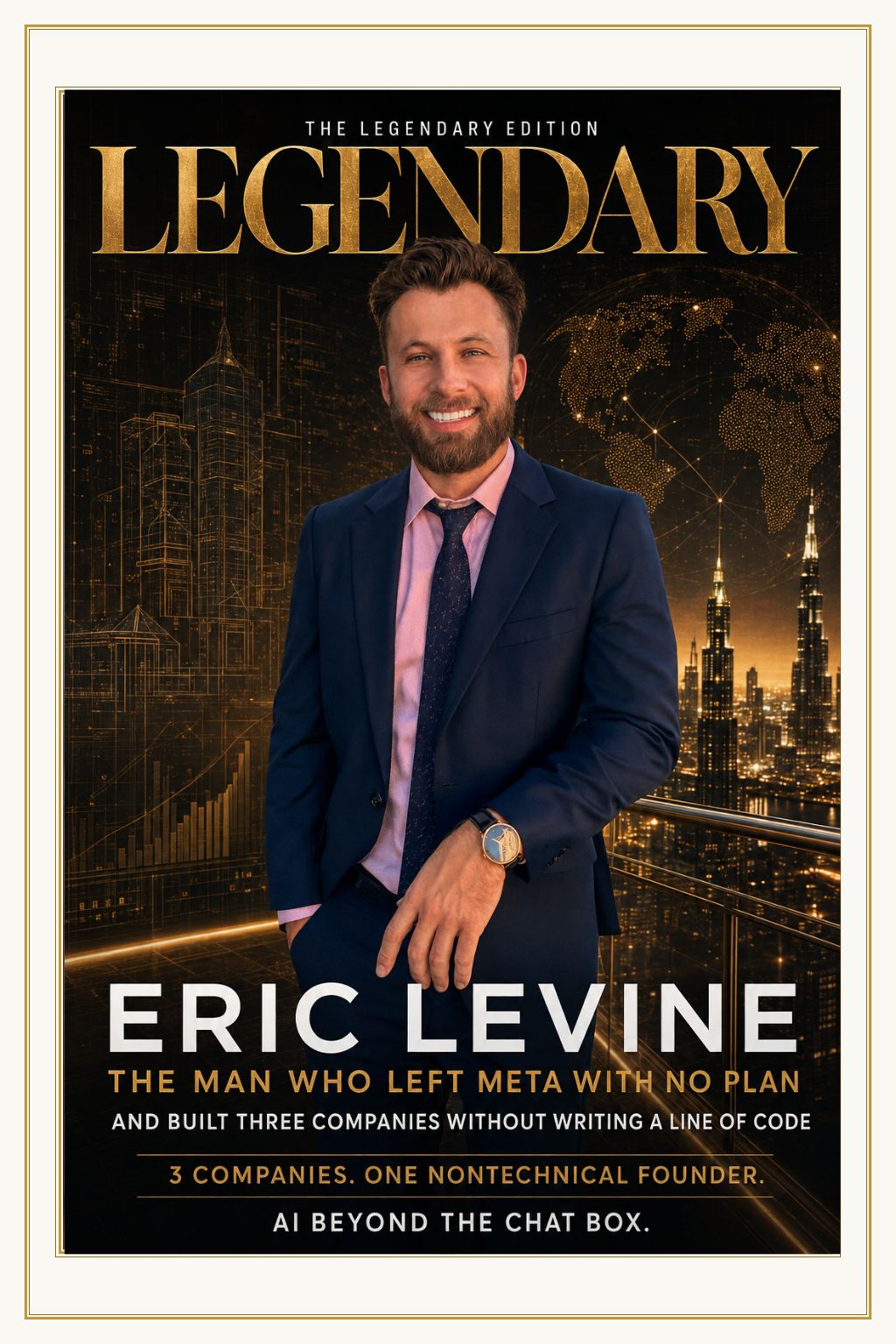
THE MAN WHO LEFT META
WITH NO PLAN AND BUILT THREE COMPANIES WITHOUT WRITING A LINE OF CODE
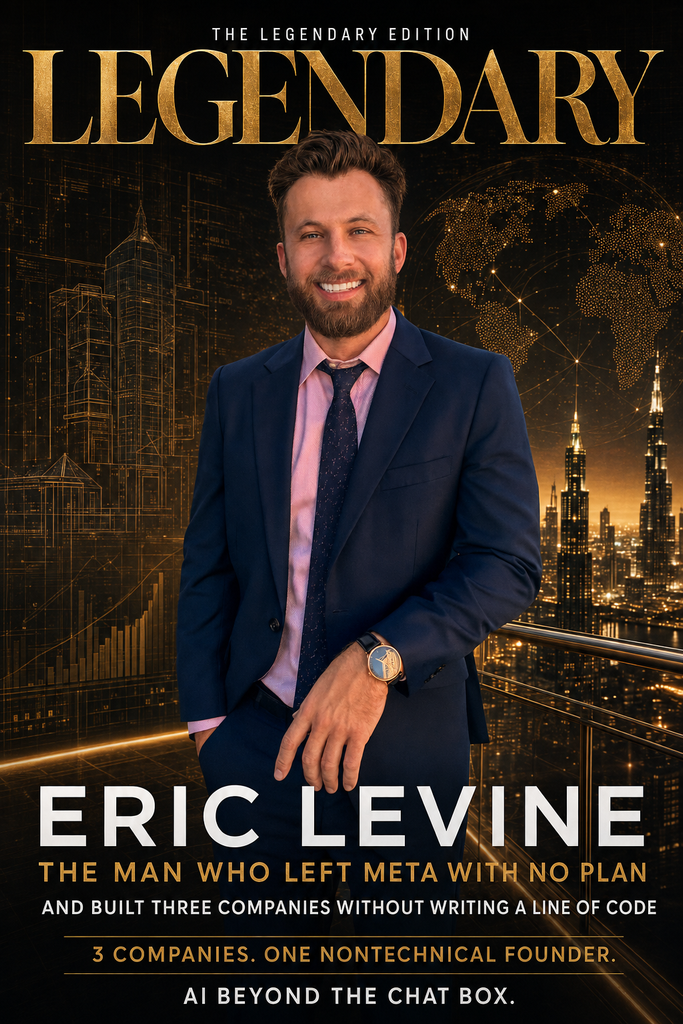
THE LEGENDARY EDITION
THE MAN WHO LEFT META
WITH NO PLAN
AND BUILT THREE COMPANIES WITHOUT WRITING A LINE OF CODE
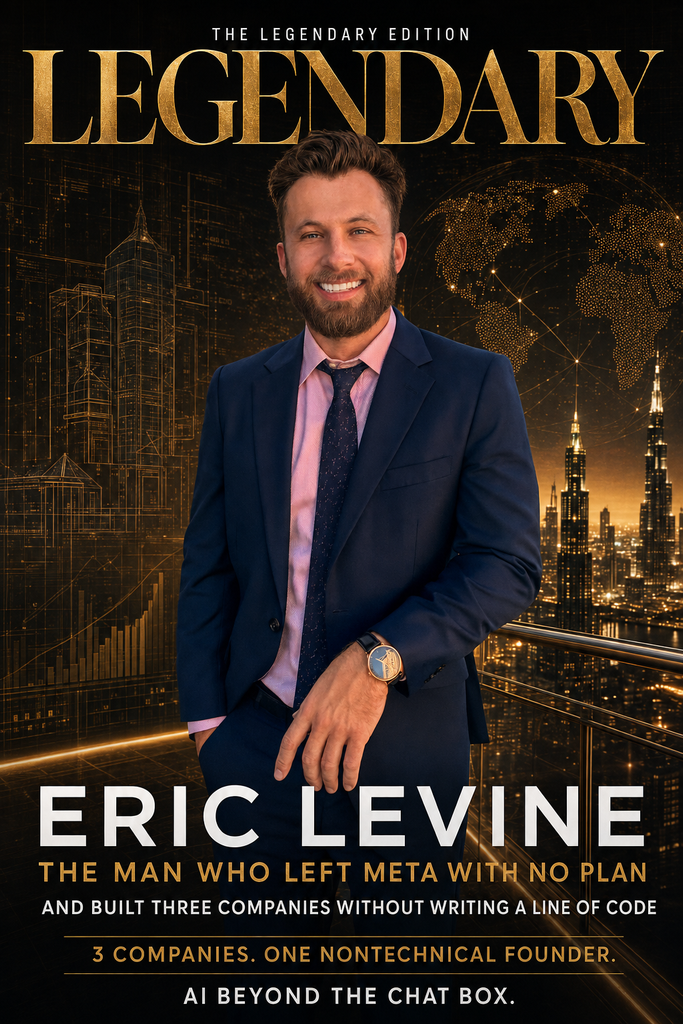
He is not teaching people how to talk to a machine. He is teaching them how to take their power back.
A philosophy major became a CPA, a strategist at Meta and, eventually, the nontechnical founder of three companies powered by AI. Now Eric Levine is opening the door for every business owner who believed the future was reserved for coders.
Some people enter the future loudly. They arrive with complicated words, impossible diagrams and enough technical language to make everyone else feel late. Eric Levine is doing something far more revolutionary: he is holding the door open. His message to business owners is not that they must become engineers. It is that the intelligence, experience and judgment they already possess may be exactly what they need to build what comes next.
I have spent years watching brilliant people underestimate themselves because technology made them feel excluded. They have ideas, clients, courage and lived experience, but the moment someone says code, automation or agents, they step backwards. Eric understands that hesitation because he began on the same side of the wall. He knew how to use an AI chat box. He could see that something much bigger existed beyond it. What he could not find was a bridge designed for a person who did not already speak the language of software.
So he built the bridge himself. Today, Eric runs three real companies with AI. He manages their websites, analytics, discoverability and automations without a technical co-founder and without writing code in the traditional sense. Then he did something that immediately caught my attention: instead of keeping the method behind an expensive curtain, he began teaching it freely through Eric Grows Companies. His work is not a performance about the future. It is proof that the future can already be used by the people who are busy running businesses today.
The least strategic decision of a strategist’s life
Eric did not arrive here through the neat career journey people normally manufacture for a biography. He studied philosophy at the University of Michigan, became a CPA, worked at Deloitte and Virgin Hyperloop, earned an MBA from UCLA Anderson, and eventually spent five years in strategy and operations at Meta. There, he worked on the playbook for how Facebook and Instagram competed with TikTok. From the outside, this was the kind of career a person protects. It was prestigious, intelligent and understandable.
But in 2024, Eric left Meta without another job waiting, without a startup ready to announce and without a perfectly engineered plan. He has described it as the least strategic decision a strategist could make—and one of the best decisions of his life. That detail matters. Reinvention is often edited after the fact until it looks like certainty. The truth is usually much less comfortable. Sometimes the next version of your life begins before you can explain it, sell it or prove it.
Eric allowed himself to sit in that uncertainty. He took a gap year. The man trained to locate structure inside complicated business problems temporarily stopped demanding a structure from his own future. What looked random began revealing a pattern: philosophy had taught him to search for the architecture beneath an argument; accounting had taught him discipline; operations had taught him how systems behave; strategy had taught him how separate decisions become one direction. None of those chapters had been wasted. They were preparing him to direct an intelligence capable of building the pieces he could imagine.

The first product began with a personal problem: a diver who could not find the app he wanted.
The dive that changed the direction
The first company did not begin in a boardroom. It began with scuba diving. Eric had filled a paper dive log and wanted a better way to preserve his records. Preparing for trips also meant repeating the same exhausting logistics: equipment, water temperature, wetsuit thickness, weight, paperwork and the constant fear of forgetting something important. He tested existing apps and none of them worked the way he wanted. So during his gap year, he decided to build his own.
That decision became SCUBAzen, a mobile app that helps divers plan trips, organize gear, estimate equipment needs, prepare paperwork and maintain a searchable dive log. It was initially built to solve Eric’s own problem, which gave him an unusual freedom: even if it never became a commercial empire, it had already succeeded. More importantly, it taught him that a nontechnical person could move from frustration to a functioning product by learning how to describe the desired result, its structure and the relationship between its parts.
This is where Eric’s philosophy becomes powerful. AI did not magically hand him a company. His judgment directed the work. He knew the problem because he had lived it. He understood what the user needed because he was the user. AI compressed the distance between the idea and the execution, but the soul of the product still came from a human being.
Three companies—and three forms of proof
SCUBAzen was only the beginning. Eric went on to build StratEngine AI, a strategy platform created for small-business owners who face serious decisions without a strategy department or the budget for a traditional consulting engagement. A business owner can bring the platform a real question—whether to raise prices, enter a market, expand a location or launch a new offer—and receive a researched, structured strategy brief designed to challenge assumptions rather than simply applaud them.
His third business, Venice Threads Co., is an apparel brand born in Venice, California. It began with designs Eric wanted to place on clothing and became another experiment in what one person could create and operate through print-on-demand systems, search visibility and AI-supported execution. One business is strategic and analytical. One comes from the ocean. One is creative and visual. Together, they destroy the idea that Eric’s method works only for one kind of company.
Each business demonstrates something different. StratEngine AI shows that sophisticated strategic work can become accessible to organizations that were previously priced out. SCUBAzen shows that a company can be designed to require very little daily attention from its owner. Venice Threads Co. shows that a small brand can be created, positioned and discovered without assembling an agency around it. The companies are not distractions from Eric’s educational work. They are the evidence beneath every lesson he teaches.
“He is not selling people a collection of tools. He is teaching them ownership.”

From the ocean to the operating system: Eric’s businesses began with problems he genuinely wanted to solve.
Beyond the chat box
Most business owners have already experimented with AI. They use it to draft an email, rewrite a caption or brainstorm a list. Then they stop. They sense that the technology could do more, but everything beyond the chat window appears to require a vocabulary, technical background or expensive specialist they do not have. Eric calls attention to this missing middle. The problem is not that owners are refusing the future. The problem is that almost no one has shown them the next practical step in language they can understand.
Through Eric Grows Companies, he teaches business owners how to take control of six essential parts of their operations: the website, the numbers, discoverability, repetitive work, AI agents and the company’s growth plan. The complete course is available free on YouTube. For owners who want a classroom, direct attention and hands-on support, he also teaches a live cohort called Run Your Whole Business with AI.
The distinction matters. Eric is not promising to drop a finished collection of automated tools into someone’s company and disappear. A system handed to you can become another cage: the moment it breaks or the business changes, you are dependent again. He teaches the underlying skill so the owner understands what was built, can improve it and can direct the next version. Ownership is not merely having the files. Ownership is no longer being afraid to touch them.
Technology without humanity is only machinery
I believe deeply in AI. I use it to create music, develop ideas, build media and accomplish in hours what once demanded an entire team. But I also believe that AI without a human soul does not work. Technology can accelerate an empty message just as easily as it can amplify a meaningful one. The difference is the person directing it—the experience, scars, instinct, standards and intention behind the instruction.
This is why Eric’s story belongs in The Legendary Edition. He does not erase the human being from business. He returns the human being to the work only a human should do: relationships, judgment, imagination, empathy and the courage to decide. The repetitive weight can move elsewhere. The owner can stop spending every evening acting as the accounting department, web department, analytics department and administrative assistant. AI becomes valuable when it creates more space for a person to think, connect and lead.
There is also something refreshingly honest about Eric’s positioning. He is not presenting himself as an engineer. He is not pretending that every problem should be automated. He does not teach founders to create enormous fleets of agents that require constant supervision. He teaches people to understand the architecture of the outcome they want and to build useful systems around real business needs. Simplicity is not the absence of intelligence. Very often, it is evidence that someone understands the subject well enough to remove the fear from it.
The revolution belongs to the people who were left outside
For decades, building a technology company required access: access to capital, developers, networks and the confidence to enter rooms where an idea could become infrastructure. That gate has not disappeared, but it is opening. A shop owner, consultant, independent creator or founder can now test an idea, build a website, understand their numbers, automate work and create a product without asking permission from an entire industry first.
That does not mean everyone will succeed. AI does not replace courage, discipline or the willingness to learn. It does not automatically create a good offer or a meaningful mission. What it changes is the cost of trying. It gives more people the ability to transform knowledge into something real. For the underdog, the independent founder and the person who has spent years believing they arrived too late, that change is not small. It is revolutionary.
Eric Levine is part of this revolution because he is translating possibility into a sequence a real owner can follow. He has crossed the confusing territory himself, built three different businesses inside it and returned with a map. His authority does not depend only on the name Meta, the CPA credential or the MBA. It comes from implementation. He is doing the work he is inviting other people to do.
This is only the beginning
Today, The Legendary Edition introduces Eric Levine as a founder who left certainty, entered the unknown and discovered that one capable human being could build far more than he had been taught to imagine. But this feature is not the conclusion of his story inside our universe. It is the opening chapter.
You will be seeing Eric’s ideas travel across the We Legendary World—through our conversations, our platforms and the international editions that connect entrepreneurs across cultures and continents. His message is too relevant to remain trapped in one market, because the business owner feeling intimidated by AI in California is not so different from the founder facing the same wall in Mexico, Arabia, Africa, Europe, Asia or beyond. The tools may change. The fear is universal. So is the desire to build something of your own.
Some stories are heard. Others become legendary because they arrive at exactly the moment people need permission to believe differently. Eric’s story says you do not need to become someone else before you begin. You do not need the perfect plan. You do not need to know how every line is written. You need to understand the problem, describe the future you want and remain willing to learn your way toward it.
The man who once left one of the world’s most powerful technology companies without a plan is now giving business owners one. Not a fantasy. Not a motivational slogan. A working path from the chat box to a business they can finally operate, understand and own.
| ericgrows.com https://maven.com/ericgrows/run-your-whole-business-with-ai https://stratengineai.com/ https://scubazenapp.com/ https://venicethreads.co/ |
IF YOU DON’T HAVE A STAGE, CREATE ONE.
