


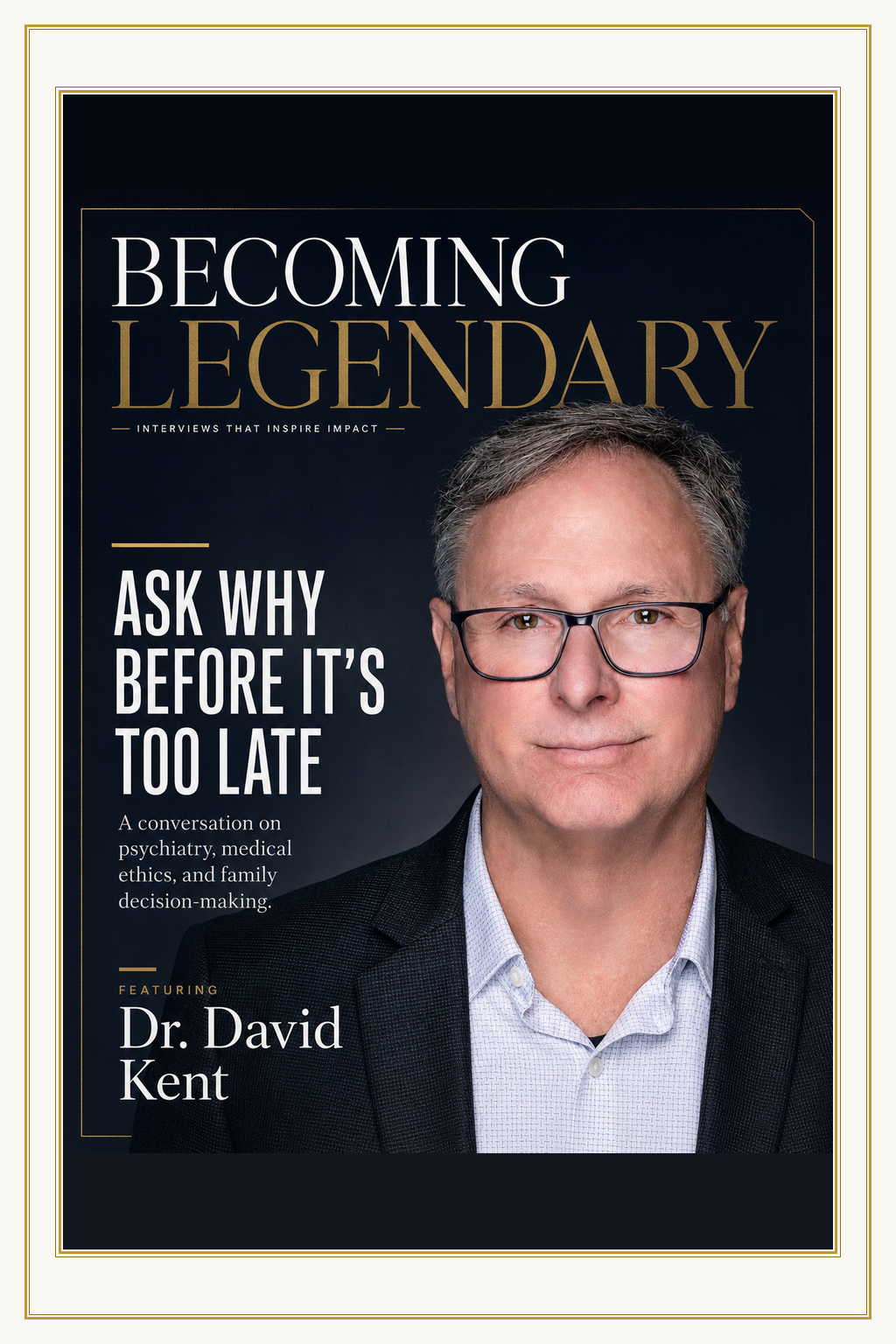
ASK WHY BEFORE IT’S TOO LATE
What 36 years in psychiatry taught one doctor about family, guilt, medical decisions — and the conversations we should have before someone else is forced to have them for us.
By Ana Rita Valente | The Legendary Edition
Dr. David A. Kent is a board-certified psychiatrist with more than thirty-five years in practice. For sixteen of those years he served as medical director of the largest geriatric psychiatric inpatient facility of its kind in his region, where life-and-death decisions were a daily reality. He is the author of Why Me? The Brain on Tilt and Ask Why? Medical Ethics 101, both written to make the hardest questions in medicine understandable to everyone. A natural storyteller, Dr. Kent turns heavy, intimidating subjects — mental illness, end-of-life choices, and the medical decisions that eventually confront us all — into conversations people can’t stop thinking about.
There are some people you meet and immediately understand that their greatest value is not simply what they know.
It is what they have seen.
Dr. David Kent has seen a lot.
Thirty-six years as a practicing psychiatrist.
Sixteen years working as a medical director in a geriatric psychiatric unit.
Thousands of patients.
Families sitting across from him during some of the most frightening, painful and confusing moments of their lives.
Dementia.
Alzheimer’s disease.
Mental illness.
Medical crises.
End-of-life decisions.
And the question that hangs over so many of those moments:
What do we do now?
When I spoke with David, I initially thought we were going to have a conversation about a psychiatrist and his new book.
Instead, I found myself thinking about something much more personal.
What would happen if tomorrow I could no longer speak for myself?
Would the people who love me actually know what I wanted?
Would they know when I wanted doctors to continue fighting?
Would they know when enough was enough?
Would they agree with each other?
Would they feel guilty?
And perhaps most frightening:
Would they simply have to guess?
Suddenly, David Kent’s book did not feel like a book about “medical ethics.”
It felt like a conversation almost every family will eventually need — and almost nobody wants to have.
THE TWO WORDS THAT CAN CHANGE EVERYTHING
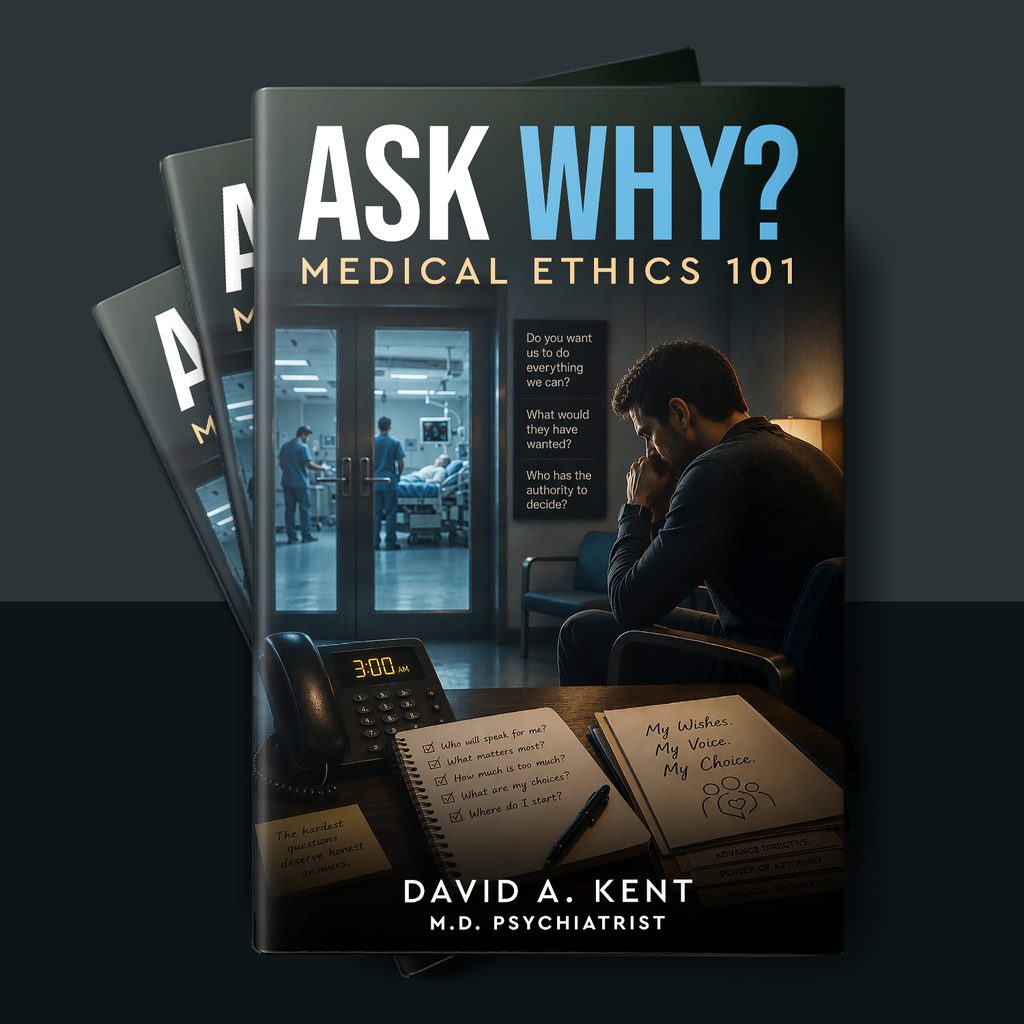
David’s latest book is called Ask Why? Medical Ethics 101.
I love the title because “why” has always been one of my favorite words.
David loves it for a different, but beautifully complementary, reason.
He believes asking why is fundamental to advocating for ourselves.
Why is this treatment being recommended?
Why do I need this test?
Why are these the available choices?
Why does the doctor believe this is the best option?
Why would we continue treatment?
Why might we stop?
Why does one member of the family believe one thing while another believes something completely different?
David told me that people should not simply listen. They should ask questions until they understand enough to participate meaningfully in decisions about their own lives.
That sounds simple.
It is not.
Medicine can be intimidating.
Doctors have knowledge we do not have.
Hospitals can make people feel small.
Fear can make us stop processing information.
And when somebody we love is critically ill, logic may suddenly have to compete with panic, history, religion, culture, guilt and hope.
That is precisely where David has spent much of his career.
36 YEARS OF LISTENING TO PEOPLE AT THEIR MOST HUMAN
David Kent is a medical doctor specializing in psychiatry and has practiced for 36 years. He told me that as he reaches the later stage of his professional career, he does not want decades of knowledge and experience simply to disappear.
So he writes.
Not only for other physicians.
For us.
For ordinary families.
For people who may never study medicine but who will nevertheless find themselves making medical decisions.
His application puts his mission very clearly: he is fighting for better understanding of mental illness and greater transparency in medical decision-making.
And there is one particular part of his career that gives this mission enormous emotional weight.
For sixteen years, David served as a medical director in a geriatric psychiatric unit.
He dealt with end-of-life issues continually.
He met with families week after week.
Many of the patients had dementia or Alzheimer’s disease and could no longer fully participate in decisions about what happened next.
And that meant the family had to.
Sometimes David’s role was medical.
Sometimes, I think, it was profoundly human.
He told me that many of those conversations were ultimately about giving families permission to let go.
Read that sentence again.
Permission to let go.
Because love can make letting go feel like betrayal.
WHEN LOVE AND GUILT BECOME THE SAME THING
Imagine that someone you love is very sick.
Doctors can continue treatment.
Technically, something else can always be attempted.
Another procedure.
Another intervention.
Another hospital admission.
Another machine.
And suddenly the family starts asking itself:
If we stop, are we giving up?
If we say no, are we responsible for what happens next?
If Mom dies after we agree not to continue aggressive treatment, did we cause her death?
If Dad once told us he never wanted to live like this, are we honoring him — or abandoning him?
This is where medicine becomes much more than medicine.
It becomes morality.
Family history.
Religion.
Fear.
Love.
Guilt.
And David saw those emotions repeatedly.
He explained that when families understood they were not doing something cruel by allowing a natural death, many experienced profound relief. He even said that some of the most meaningful thank-you messages he received throughout his work came from families he helped through exactly those moments.
That struck me deeply.
Because sometimes helping somebody does not mean giving them another treatment.
Sometimes it means helping them understand that love does not always mean holding on.
THE MOST IMPORTANT MEDICAL CONVERSATION MAY HAPPEN BEFORE YOU ARE SICK
Here is where David’s message becomes urgent.
Many of us wait until there is a crisis to discuss what we want.
That is exactly when the conversation becomes most difficult.
David points out that when we cannot speak for ourselves and have left no clear written instructions, everybody else is left guessing.
And families do not always guess the same thing.
One child remembers Dad saying he never wanted machines keeping him alive.
Another remembers him saying he would fight until the very end.
A spouse has one interpretation.
A sibling has another.
Suddenly an already devastating situation becomes a family conflict.
Not because anybody is bad.
Because everybody loves the same person differently.
David’s work made me think that perhaps one of the greatest gifts we can give our family is clarity.
Tell them.
Write it down.
Have the uncomfortable conversation while you are still healthy enough to laugh afterward.
What matters to you?
What does quality of life mean to you?
What would you consider an acceptable level of independence?
Who do you trust to speak for you?
What do you believe about life-prolonging treatment?
These are not conversations about wanting to die.
They are conversations about how you want to live.
And about protecting the people you love from having to invent your answers.
MEDICAL ETHICS IS NOT ONLY FOR DOCTORS
The title Medical Ethics 101 might make some readers imagine an academic textbook.
That is not what David wanted to create.
He intentionally wrote the book in plain language because his goal is to help normal people understand difficult decisions.
That matters.
Because ethics sounds theoretical until the person in the hospital bed is your mother.
Your father.
Your child.
Your husband.
Your wife.
Or you.
Then ethical questions stop being philosophy.
They become Tuesday morning.
David talks about patients who cannot speak for themselves, guardianship, severe mental illness, adolescents and situations where legal systems may have to intervene.
And he makes another point that fascinated me:
There is not always one simple “right” answer.
Our decisions are shaped by who we are.
Culture.
Religion.
Childhood.
Family.
Personal experience.
The same medical situation presented to two families may produce very different conclusions because those families understand life, suffering, autonomy and death differently.
That is exactly why asking why matters.
Why do I believe this?
Why am I choosing this?
Am I choosing for the patient?
Or am I choosing based on what I cannot emotionally tolerate?
Those can be very different things.
THE DOCTOR WHO DOESN’T WANT TO TELL YOU WHAT TO THINK
One thing I particularly appreciate about David’s approach is that he is not trying to write a book that gives everybody the same answer.
He told me from the beginning that the purpose is not to tell people which decisions to make.
It is to help them understand how to make those decisions in a way they can feel comfortable with afterward.
That distinction is enormous.
Because medical ethics is not a menu with “correct” highlighted in green.
Life is messier than that.
Medicine is messier than that.
Families are definitely messier than that.
A good decision is sometimes not the decision that eliminates pain.
Sometimes there is no painless decision.
Perhaps it is the decision made with the clearest possible understanding of the facts, the person’s wishes and the reasons behind the choice.
That is where David’s favorite word returns.
Why?
FROM MENTAL ILLNESS TO MEDICAL DECISION-MAKING
David actually has two books built around that word.
The new book is Ask Why? Medical Ethics 101.
His other book focuses on mental illness and is titled Why Me? The Brain on Tilt, now in its second edition.
I find that pairing fascinating.
Why me?
and
Ask why.
One is the question we ask when life happens to us.
Why me?
Why did I get sick?
Why did this happen to my family?
Why is my mind doing this?
The other is active.
Ask why.
Understand.
Participate.
Advocate.
Question.
Choose.
There is almost an entire philosophy hidden between those two book titles.
Maybe we cannot always answer why something happened to us.
But we can become more active in asking why something is being done for us or to us.
That is empowerment.
THE KNOWLEDGE HE DOESN’T WANT TO LOSE
David said something early in our conversation that I think explains why he is writing now.
After 36 years in psychiatry, he knows he is moving toward the later chapter of his career.
He has accumulated experiences and knowledge that he does not want to disappear when he eventually stops practicing.
I understand that instinct completely.
What is the point of learning something for decades if we never pass it forward?
Legacy does not always mean building a giant company.
Sometimes legacy is taking what thirty-six years taught you and translating it into language somebody can understand at two in the morning when their family is falling apart.
That is what I see in David Kent.
Not simply a doctor promoting a book.
A doctor trying to leave behind a map.
BEFORE IT IS TOO LATE, ASK
Ask your doctor.
Ask your parents.
Ask your partner.
Ask yourself.
What do you actually want?
Why?
What are you afraid of?
What would quality of life mean if circumstances changed?
Who should speak for you?
What assumptions are you making?
What have you never said out loud because talking about illness and death feels uncomfortable?
Have the conversation.
Because one day it may no longer be theoretical.
And perhaps the most loving thing you can do is make sure the people standing beside your hospital bed are not forced to guess what love requires.
That is why I believe David Kent’s message deserves to travel far beyond the medical world.
It is about medicine.
But it is also about family.
Autonomy.
Fear.
Compassion.
Responsibility.
And courage.
I began our conversation thinking I was interviewing a psychiatrist about medical ethics.
I finished it thinking about my own life.
My own family.
My own choices.
And the questions I still need to answer.
That, to me, is what a powerful book does.
It does not simply give you information.
It makes you look at your own life differently.
And sometimes it leaves you with one extraordinarily simple instruction:
ASK WHY.
Before the crisis.
Before the confusion.
Before somebody else has to answer for you.
Ask why before it’s too late.
DISCOVER DR. DAVID KENT
Dr. David Kent
Psychiatrist • Author • Advocate for Mental Health Understanding and Transparent Medical Decision-Making
Author Website
https://www.davidkentauthor.com
David’s website includes information about his work and direct purchase links for both books. He also confirmed that both titles are available through Amazon.
ASK WHY? MEDICAL ETHICS 101
A plain-language exploration designed to help individuals and families better understand difficult medical decisions, including end-of-life choices.
WHY ME? THE BRAIN ON TILT — SECOND EDITION
David Kent’s book exploring mental illness and helping readers better understand what happens when the brain and mental health become disrupted.
WATCH DR. DAVID KENT ON BECOMING LEGENDARY
In his conversation with Ana Rita Valente, Dr. David Kent discusses 36 years in psychiatry, medical ethics, mental illness, family conflict, end-of-life decisions, patient advocacy and why learning to ask “why?” may be one of the most important things we can do for ourselves and the people we love.
Hosted by Ana Rita Valente
Becoming Legendary | We Legendary
