



After nearly five decades of building, leading, winning, failing, loving, learning and starting again, Victor Bretting has discovered that strength is not simply the ability to take the hill. Sometimes, strength is knowing when to listen, when to surrender — and when to let yourself be changed.

VICTOR BRETTING: THE MAN HE WOULD BECOME
After nearly five decades of building, leading, winning, failing, loving, learning and starting again, Victor Bretting has discovered that strength is not simply the ability to take the hill. Sometimes, strength is knowing when to listen, when to surrender — and when to let yourself be changed.
By The Legendary Edition
🎧 Prefer to listen?
Experience the full story in audio. Sit back, press play, and listen to the complete article, “Victor Bretting: The Man He Would Become.”
There is a moment in a conversation with Victor Bretting when the architecture of the man begins to reveal itself.
He is talking about leadership.
For nearly five decades, construction has been one of the defining forces of his life. He became a foreman at just 19 years old. He would go on to lead teams, move into executive leadership, own a company and spend decades operating in environments where hesitation can cost time, money, trust and sometimes much more.
Victor learned how to make decisions.
How to carry pressure.
How to solve problems.
How to take the hill.
And, perhaps most importantly, how not to quit.
Then life presented him with a far more difficult construction project:
himself.
Today, at 67, Victor L. Bretting is an author, rancher, businessman, outdoorsman, husband, father and a man increasingly interested not simply in what he has built, but in what all of it means.
His memoir, The Man That I Would Become, explores precisely that territory: grit, faith, fatherhood, leadership, failure, redemption and the long process of becoming. His official biography describes a journey stretching from football fields and nuclear power plants to executive leadership and ranch life.
But titles only explain part of Victor Bretting.
To understand the man, you have to go much further back.
THE WOMAN WHO TAUGHT HIM NOT TO QUIT
Victor grew up largely without a present father.
His memories of his father are limited. His parents eventually divorced, and his father died when Victor was 16.
The dominant force in his upbringing was his mother.
“My mom was my leader,” he says.
She worked extraordinary hours. She provided. She kept going.
And her son watched.
She grounded him in faith. She put him into sports. She taught him responsibility and the importance of being part of a team.
The message was simple:
You have a job to do.
Do it.
Don’t let the person beside you down.
Don’t quit.
Sports reinforced the lesson. Life reinforced it again.
That mentality became one of Victor’s greatest assets.
It also created one of his greatest challenges.
Because the little boy learning resilience was simultaneously learning another lesson: pain was something to endure quietly.
Victor describes the message many boys receive almost from the moment they first fall off a bicycle.
Get up.
You’re okay.
Stop crying.
Keep going.
For Victor, it worked.
He became extraordinarily resilient.
He could carry enormous pressure.
He could march forward when others stopped.
He could survive.
But eventually he would discover that every great strength casts a shadow.
Victor has a name for this philosophy.
A “Victorism.”
THE TEN AND THE ONE
Victor believes many of our strongest qualities come with an opposite weakness.
If life gives you a ten somewhere, he argues, there is probably a one hiding somewhere else.
His ten was obvious.
Pressure.
Determination.
Execution.
He could take the hill.
Put an obstacle in front of him and his instinct was not to retreat. It was to figure out how to get through it.
But his one?
Feelings.
Empathy.
Vulnerability.
The same man who could successfully lead people through enormously demanding professional environments struggled to access the emotional tools required in intimate relationships.
That realization did not arrive gently.
There were failed relationships.
There were mistakes.
There were moments when it was easier to point outward than inward.
Eventually Victor had to confront a question most people spend enormous energy avoiding:
What if some of the problem is me?
That question became unavoidable professionally as well.
At one point in his career, a mentor told him that if he wanted to become an executive, he would have to change.
Victor attended an intensive leadership program built partly around 360-degree feedback.
First came the praise.
Driven.
Strong.
A leader people would follow.
A man who would make things happen.
Then came the other side.
He needed to listen more.
He needed to stop overpowering the room.
The feedback was not comfortable.
But Victor realized he had two choices.
Everyone else was wrong.
Or Victor needed to change.
He chose change.
Not erasure.
Not becoming somebody else.
Change.
For a period, Victor misunderstood what balance required. If his natural leadership style was a ten and emotional sensitivity was a one, perhaps both needed to become fives.
It didn’t work.
The answer, he eventually realized, wasn’t to destroy the ten.
It was to develop the one.
Maybe the one could become a two.
Then a three.
Then a four.
He could remain decisive without becoming deaf.
He could remain strong while learning empathy.
He could lead and still listen.
That distinction would become central to the man Victor was becoming.
THE WOMAN WHO SAW HIM BEFORE HE DID
Then came the woman who would change his personal life.
When Victor met the woman who became his wife, she had spent approximately eight years raising her boys independently.
She knew how to survive without a man.
Victor, meanwhile, was hardly preparing to settle down.
He admits that he was dating multiple women when they met.
His future wife apparently had a rather different reaction.
After their first date, she went home believing she had met the man she loved.
Victor took longer.
Much longer.
They were together for roughly three years before marrying and have now been together for approximately 16 years.
Why did he wait?
Because he had already made mistakes, and he did not want to repeat them.
There was another reason too.
Love required something from Victor that construction never had.
Surrender.
To truly love somebody, he began to understand, he would have to stop keeping an emotional escape route.
He would have to give someone his heart without maintaining what he jokingly describes as a “spare tire.”
He would have to trust.
His wife waited.
Not passively, but patiently.
She challenged him.
She established boundaries.
She taught him that vulnerability didn’t diminish him.
She showed him that he could have feelings without losing his strength.
“She waited for me a long time to come to the person she knew I could be,” Victor recalls.
Today, he credits her profoundly.
He jokes about crying during movies and immediately threatens to deny it.
The humor matters.
Because beneath it sits something much bigger.
The man who once regarded vulnerability almost as a foreign language can now discuss it publicly.
For Victor, that is evolution.
WHAT DOES IT MEAN TO BE A MAN?
This is where conversations with Victor become more complicated — and more interesting.
He holds traditional views about masculinity and relationships.
He believes a man should protect his family, provide leadership, cherish his wife, support her and earn her trust.
He speaks openly about traditional roles.
But his version of masculinity has also evolved.
Strength, in Victor’s world, cannot simply mean dominance.
Leadership without listening failed him.
Strength without empathy cost him.
Self-reliance without vulnerability created distance.
The older Victor appears less interested in proving that men are invulnerable and more interested in asking what happens when men are never taught how to speak about what hurts.
That question leads directly into a subject he believes deserves much deeper discussion:
men’s mental health.
Victor sees a connection between the messages boys receive about suppressing pain and the difficulties many men later experience expressing emotional distress.
He doesn’t argue that resilience is wrong.
Quite the opposite.
He treasures it.
What he questions is whether resilience without emotional language leaves men with all the equipment required to survive externally and too few tools for what happens internally.
That tension may become one of the most important chapters of Victor Bretting’s public story.
Because his message is not:
Stop being strong.
It is:
Strength can become bigger.
PURPOSE IS NOT SURVIVAL
There is another distinction Victor makes repeatedly.
Survival and purpose are not the same thing.
Getting up.
Going to work.
Paying bills.
Feeding your family.
Sleeping.
Repeating.
Those things may be necessary.
But necessity is not necessarily purpose.
For much of his life, Victor had goals.
Professional milestones.
Outdoor achievements.
Targets to pursue.
Another mountain.
Another objective.
Another reason to keep moving.
But he says his deeper purpose did not become clear until his early sixties.
That matters.
We live in a culture obsessed with discovering a calling early, monetizing it quickly and presenting the resulting journey as though every step had been obvious.
Victor’s life suggests something very different.
Sometimes purpose arrives after decades of living.
Sometimes you have to build before understanding why you were building.
Sometimes you have to fail.
Sometimes you have to become successful enough to discover that success itself is not the answer.
Today, Victor describes his purpose much more simply:
Give back.
Help people.
Leave something useful behind.
LEGACY IS NOT AN INHERITANCE
Victor talks about legacy frequently.
But his definition has little to do with accumulated wealth.
He tells his children that their inheritance is not his legacy.
Money can be transferred.
Property can be transferred.
A ranch can be transferred.
But legacy requires continuation.
The values have to survive.
The giving has to continue.
The doors have to remain open.
The next generation has to understand why any of it existed in the first place.
That philosophy is visible at Bretting Texan Ranch, the North Texas property Victor built into both a hunting operation and an extension of his values.
Victor said during his conversation with Rocky Valente that he and his family had donated 64 hunts over the preceding three years to groups including combat veterans and terminally ill children.
For him, the ranch is therefore not simply land.
It is an instrument.
A place where his beliefs about outdoorsmanship, faith, service, mentorship and human connection can become tangible.
And it is where another complicated conversation begins.
THE RANCH, THE HUNTER AND THE CONVERSATION WE AVOID
Victor is a hunter.
He makes no attempt to disguise it.
For some audiences, that fact alone will generate an immediate opinion.
Victor knows that.
So does Rocky Valente.
Rather than avoid the disagreement, their conversation moves toward it.
Hunting.
Animals.
Conservation.
Food.
Stewardship.
Responsibility.
What does it mean to claim to love animals?
What responsibilities come with taking an animal’s life?
What role do hunters play in conservation?
What happens when people consuming meat are psychologically separated from the reality of where that meat came from?
Victor intends to enter those conversations directly.
Not because everyone will agree with him.
They won’t.
But because disagreement is one of the central themes of his worldview.
He believes modern society has become too comfortable shouting and too uncomfortable listening.
TWO EARS. ONE MOUTH.
Victor’s grandfather gave him advice that stayed with him:
God gave you two ears and one mouth.
Learn to listen.
It sounds almost comically simple.
It isn’t.
Victor believes one of the great failures of contemporary communication is the assumption that speaking louder constitutes winning.
It doesn’t.
Shouting someone down doesn’t mean you’ve changed their mind.
It may only mean you’ve prevented them from speaking.
His decades in negotiation and leadership taught him something else: once emotion completely hijacks a negotiation, judgment suffers.
Sometimes strength means responding.
Sometimes it means remaining calm.
Sometimes it means walking away.
And sometimes the person across from you knows something you don’t.
For a man whose younger self was known for charging forward, there is something almost poetic about this becoming one of his central messages:
Listen.
CONSTRUCTION WAS NEVER JUST ABOUT BUILDINGS
After nearly five decades in construction, Victor still loves building.
He built much of what exists on his ranch with his own hands and still speaks about construction with the energy of someone who has not psychologically retired from the work.
His leadership philosophy is intensely practical.
When Victor walks onto a project, he says he isn’t primarily interested in admiring everything that is correct.
He’s looking for what is wrong.
Where is the hole?
What hasn’t the team noticed?
What could derail the project tomorrow?
Leadership, to him, means helping people see the problems before they fall into them.
Plans change.
The original Plan A may mutate repeatedly before a project is complete.
That isn’t necessarily failure.
The leader’s responsibility is to adapt while keeping sight of the destination.
It is difficult not to hear the metaphor.
Because that is also Victor Bretting’s life.
Plan A changed.
More than once.
Relationships changed.
His understanding of leadership changed.
His understanding of masculinity changed.
His relationship with vulnerability changed.
His understanding of purpose changed.
But he kept building.
FAITH, CONTROL AND THE COURAGE TO SURRENDER
Faith is another foundation in Victor’s life.
He does not describe it as a decorative belief reserved for easy times.
For him, faith becomes most important precisely when control disappears.
And control is particularly interesting territory for someone like Victor.
This is a man whose professional identity was built around taking responsibility.
Plan.
Anticipate.
Solve.
Execute.
Lead.
But eventually there are circumstances no plan can dominate.
Faith asks for something very different.
Trust.
Surrender.
The possibility that you are not controlling everything.
Victor admits surrender does not come naturally to him.
Neither does vulnerability.
But perhaps that is precisely why they matter.
If his life’s first half taught him how to exert his will upon the world, the next chapter appears to be teaching him when not to.
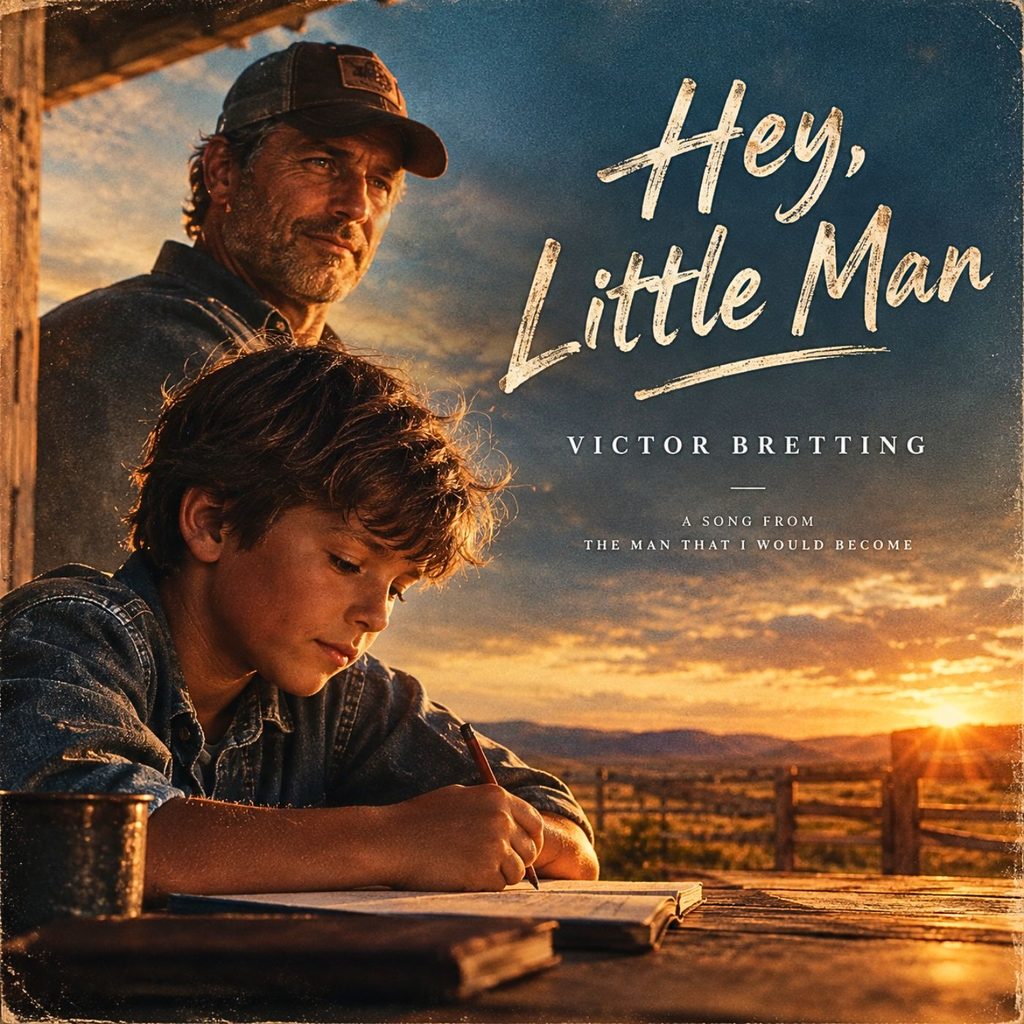
“HEY, LITTLE MAN”
And now, unexpectedly, Victor Bretting’s story is moving into music.
His first song, “HEY, Little Man,” transforms the central themes of his life into something more intimate.
The premise is deceptively simple.
An older man speaks to the little boy he once was.
The child is struggling with words on a page.
He cannot yet see the decades ahead.
The older Victor can.
He knows about the construction crews.
The leadership.
The mistakes.
The family.
The ranch.
The book.
The voice the boy doesn’t yet know he will find.
And instead of telling that child to simply toughen up, the older voice offers something Victor himself had to spend decades learning:
You can ask for help.
You don’t have to get everything right.
Your struggle today does not determine where your story ends.
The song feels almost like a conversation across time between Victor’s ten and his one.
The strong man returns for the vulnerable boy.
Not to erase him.
To tell him:
You did it.
https://ditto.fm/hey-little-man-victor-bretting
THE MAN THAT HE WOULD BECOME
Perhaps the most interesting thing about Victor Bretting is that his story refuses the neatness of a motivational poster.
He succeeded.
He also failed.
He led people.
He also had to learn how to listen.
He built businesses.
He also experienced broken relationships.
He developed enormous resilience.
He also discovered the limitations of emotional armor.
He believes deeply in masculine strength.
He also speaks about crying.
He spent decades pursuing goals.
He found his deeper purpose much later.
He believes in taking action.
He is learning surrender.
He hunts.
He speaks about stewardship.
He built a ranch.
He says legacy is not what you own.
Contradiction?
Perhaps.
Or perhaps that is simply what becoming looks like.
Human beings are not finished products.
And Victor Bretting, at 67, does not speak like a man who believes his construction is complete.
There are more conversations he wants to have.
About men.
About suicide and mental health.
About conservation.
About relationships.
About leadership.
About faith.
About purpose.
About what we owe the next generation.
About the things people are increasingly afraid to discuss with anyone who might disagree.
That is the territory Victor Bretting and Rocky Valente are entering together in We Legendary: Beyond the Man.
Not a conversation built around perfect agreement.
Something potentially much more valuable:
Two people willing to sit across from each other, ask difficult questions, laugh, disagree, listen and keep talking.
Because maybe Victor’s grandfather had it right all along.
Two ears.
One mouth.
And a lifetime to learn how to use them.

📖 The Man That I Would Become
https://brettingtexanranch.com/the-book
VICTOR L. BRETTING
Author | Rancher | Construction Executive | Outdoorsman | Speaker
🌐 Bretting Texan Ranch
https://brettingtexanranch.com/
🎵 HEY, Little Man — Victor Bretting
Pre-save: https://ditto.fm/hey-little-man-victor-bretting
🎵 Further Down the Road — Victor Bretting
Pre-save: https://ditto.fm/further-down-the-road
▶️ YouTube — Bretting Texan Ranch
https://www.youtube.com/@BrettingTexanRanch
📸 Instagram — B-Tex Ranch
https://www.instagram.com/btexranch
📘 Facebook — B-Tex Ranch
https://www.facebook.com/btexranch
💼 LinkedIn — Victor Bretting
https://www.linkedin.com/in/victor-bretting-907bb746
WE LEGENDARY: BEYOND THE MAN
A We Legendary original series hosted by Rocky Valente, featuring Victor Bretting in conversations about leadership, masculinity, vulnerability, relationships, faith, purpose, conservation and legacy.
🎙️ Connect with Rocky Valente + We Legendary World
https://linktr.ee/welegendary.world
If you don’t have a stage, create one.
