


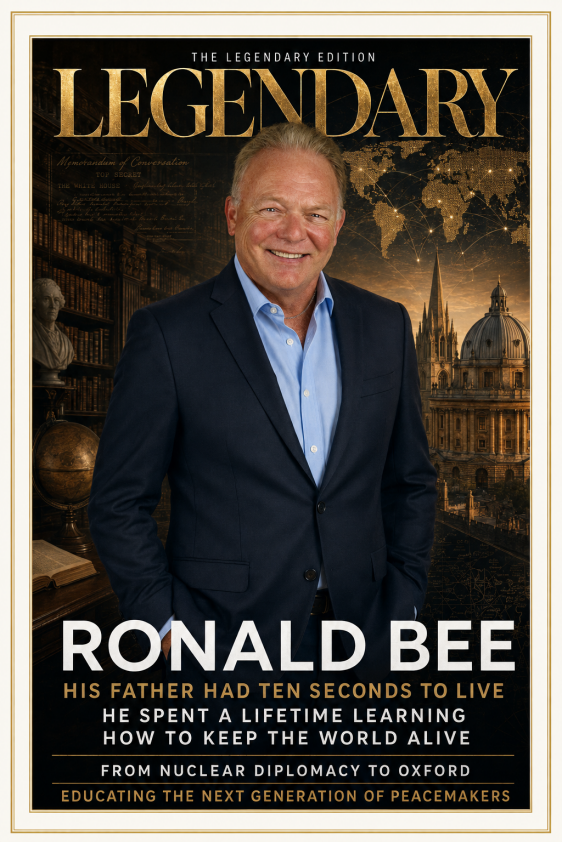
THE LEGENDARY EDITION RONALD BEE
HIS FATHER WAS GIVEN TEN SECONDS TO LIVE. RON BEE SPENT A LIFETIME LEARNING HOW TO KEEP THE WORLD ALIVE.
From nuclear diplomacy and the Pentagon to Oxford classrooms and young leaders from conflict zones, Ronald Bee has dedicated his life to replacing ignorance with understanding – and proving that education may still be humanity’s greatest instrument of peace.
A LEGENDARY EDITION ORIGINAL FEATURE
There are people whose lives begin with a dream.
Ronald Bee’s began with ten seconds.
Not his own ten seconds, but the ten seconds his father had been told he could expect to live if he reached the beaches of Japan during the planned Allied invasion at the end of World War II.
Ron’s father was not a soldier by nature. He was a musician and singer who had performed on national radio and played in San Francisco, including with Frank Sinatra’s band. Then the war interrupted the music.
Drafted into the United States Third Army in 1945, he was assigned to command six amphibious Sherman tanks. His strong singing voice, capable of carrying over noise and distance, suddenly became a military asset. He could issue commands loudly enough to be heard by the men operating the tanks.
The first wave of troops approaching Japan was expected to suffer almost unimaginable casualties. Ron’s father was told that if he successfully reached the beach, he might remain alive for approximately ten seconds.
The second wave might survive slightly longer.
The third, perhaps thirty seconds.
But the invasion never happened.
The United States dropped atomic bombs on Hiroshima and Nagasaki in August 1945. Japan surrendered, the war ended, and Ron’s father returned to the life he had almost certainly expected to lose.
LEGENDARY | 02
THE LEGENDARY EDITION RONALD BEE
He was able to make music again.
He was able to have a family.
He was able to become Ron’s father.
That knowledge created a question inside Ronald Bee that would shape nearly everything that followed: How can an event capable of causing such catastrophic human suffering also become the reason that someone you love survived?
There was no simple answer – and Ron was never interested in simple answers.
He wanted to understand what brings nations to the edge of annihilation, what prevents them from crossing it, and why diplomacy sometimes succeeds when the world seems determined to fail.
That question took him from California to Washington, from Bologna to Vienna, from the Pentagon to Berlin, from nuclear policy to international education, and eventually into Oxford classrooms where a new generation could learn to see the world beyond headlines, borders and inherited assumptions.
Ron Bee did not merely study history.
He repeatedly found himself standing inside it.
The Seven-Year-Old Who Greeted a President
Long before he became a foreign-policy expert, author, diplomat, educator and television commentator, Ron was a seven-year-old boy living in Yosemite National Park, where his parents worked as entertainment directors.
When President John F. Kennedy visited the park in 1962, Ron’s family learned where the presidential helicopter would land. Ron waited for the president and, when the opportunity came, shook Kennedy’s hand.
“Hiya, Pres!” he announced.
His mother immediately corrected him: “That’s Mr. President to you, Ronnie.” Kennedy smiled, and the encounter became a story in the Fresno Bee.
At seven, Ron could not have known that two decades later he would interview members of Kennedy’s administration about one of the most dangerous moments in modern history: the Cuban Missile Crisis.
But even then, the worlds of leadership, public service and history were already moving toward him.
In high school, Ron served as student body president and led an effort to secure equal funding for women’s sports. Years later, while attending a Pentagon reception, a stranger approached him and asked if he was the Ron Bee who had done something for women’s athletics.
Ron wondered how the man could possibly know.
LEGENDARY | 03
THE LEGENDARY EDITION RONALD BEE
The answer was unexpected: Ms. magazine had named him one of its 40 male heroes of the decade.
Long before advocacy became part of a personal brand, Ron had already learned that leadership means noticing who has been excluded – and doing something about it.
When Personal History Becomes a Calling
At the University of California, San Diego, Ron met Dr. Herbert York, a physicist who had worked on the Manhattan Project and later advised six United States presidents.
For Ron, the connection was profound. Here was a man directly connected to the development of the weapon that had helped end the war before Ron’s father was sent to the beaches of Japan.
York became Ron’s mentor and encouraged him to enter the fields of nuclear arms control and international diplomacy. He recommended Ron for a position in Washington with Americans for SALT, an organization working to support ratification of the SALT II nuclear-arms treaty.
On July 19, 1979 – the same day he received the job offer – Ron met President Jimmy Carter at the White House.
At only 24, he moved across the country to Washington, D.C., lived in a group house on a couch, beginning what would become a 15-year chapter at the center of American foreign-policy debate.
But history changed the plan almost immediately.
When the Soviet Union invaded Afghanistan in December 1979, ratification of a major arms agreement with Moscow became politically impossible. The organization’s mission – and Ron’s position – was suddenly thrown into uncertainty.
So he went to Europe.
He enrolled at the Johns Hopkins School of Advanced International Studies center in Bologna, Italy. He arrived by train in August 1980, shortly after a terrorist bombing had devastated the city’s railway station.
He entered Bologna through smoke, rubble and evidence of political violence to study international relations and national security.
For some people, education creates distance from reality.
For Ron, reality was waiting at the station.
A First Day at Work That Became World News
In 1981, Ron was hired by the International Atomic Energy Agency in Vienna.
Before reporting for his first day, he walked through Heldenplatz and noticed Nazi flags and World War II-era vehicles. For a moment, the past appeared to have returned. In reality, the square was being used to film the television miniseries The Winds of War.
LEGENDARY | 04
THE LEGENDARY EDITION RONALD BEE
But the collision between history and the present did not end there.
On the day Ron began working at the IAEA, Israel attacked Iraq’s Osirak nuclear reactor.
Hans Blix, then the organization’s director general, needed to understand how the attack was being reported internationally. Because Ron spoke French, German and Italian, he was asked to analyze and summarize coverage from British, American, French, German and Italian media.
On his first day, he was already helping one of the world’s most important nuclear institutions interpret an international crisis.
It was an early lesson in the power of language.
Translation is never only about words. It is about understanding how different countries perceive the same event, how narratives influence policy, and how quickly misunderstanding can become confrontation.
Inside the Rooms Where Decisions Are Made
After returning to Washington, Ron worked in the Foreign Affairs and National Defense Division of the Congressional Research Service at the Library of Congress.
The discipline he learned there would define his work for decades: examine all credible sides of an issue, identify the advantages and consequences of each policy option, and allow decision-makers to reach informed conclusions.
In a world increasingly organized around outrage, certainty and ideological camps, this ability has become extraordinarily rare.
Ron learned to resist the temptation to reduce complex questions into slogans.
Later, as Special Assistant for National Security Affairs at Palomar Corporation, he worked on Pentagon studies examining nuclear crises – moments when nuclear war could have happened, but did not – and what prevented escalation.
He also studied the confrontation over the deployment of American cruise and Pershing II missiles in Europe, as well as the debate over whether NATO should modernize or eliminate chemical weapons.
In 1985, Ron presented his findings during a closed-door session of the Presidential Commission on Chemical Warfare Review. He found himself before figures including Zbigniew Brzezinski, Alexander Haig, Barber Conable and the Chairman of the Joint Chiefs of Staff.
They did not want prepared testimony.
They wanted the bottom line.
Ron had to think, distill and respond in real time – an ability that would later serve him as an educator and as a foreign-policy commentator on television and radio.
LEGENDARY | 05
THE LEGENDARY EDITION RONALD BEE
Yet for all the powerful rooms he entered, Ron’s purpose was never simply proximity to power.
It was understanding how power could be prevented from destroying what it was supposed to protect.
Looking the Tiger in the Eye
At Palomar, Ron proposed writing a book based on the unclassified research he had uncovered about nuclear crises.
That proposal became Looking the Tiger in the Eye: Confronting the Nuclear Threat, co-authored with Carl Feldbaum and published by Harper & Row in 1988.
The book was recognized as a New York Times Notable Book of the Year and received a Christopher Award. It also led to Ron’s first major television interview, with CNN anchor Bernard Shaw.
That appearance opened another door. Over the years, Ron became a trusted commentator on international relations and American foreign policy, appearing on television and radio to help audiences understand wars, geopolitical tensions and the decisions shaping their world.
He has since published seven books and more than 30 peer-reviewed articles. But the deeper importance of his work is not found in the number of publications.
It is found in the mission beneath them: helping ordinary citizens understand subjects too important to be left only to governments and specialists.
Foreign policy is not an abstract conversation happening somewhere far away. It determines where wars begin, where resources go, which families are separated, who feels safe, and which young people inherit the consequences of decisions they did not make.
Touching the Berlin Wall Every Morning
Selected as a Robert Bosch Foundation Fellow, Ron spent time working with the chairman of the German Parliament’s Committee on Foreign Affairs and later with the Governing Mayor of West Berlin.
Each morning, he ran from his apartment to the Brandenburg Gate, touched the Berlin Wall, and continued past the Soviet War Memorial.
He began greeting the Soviet guards with “Dobry den” – good day. At first, there was no response.
But after several months, they began returning his greeting.
It was a small act, almost invisible against the machinery of the Cold War. It did not dismantle the Berlin Wall or rewrite a treaty.
LEGENDARY | 06
THE LEGENDARY EDITION RONALD BEE
But diplomacy often begins exactly there: with the decision to recognize a human being on the other side.
Ron also worked at Rathaus Schöneberg, the building where Kennedy had delivered his famous “Ich bin ein Berliner” speech. Each time he entered, he remembered the president whose hand he had shaken as a child.
History, once again, had completed a circle.
From Nuclear Deterrence to Human Connection
Ron’s career continued across research, diplomacy, media and international exchange.
In the early 1990s, he traveled to Moscow to help prepare approximately 1,700 young people from the former Soviet Union for a year of study with American host families.
Russia was experiencing extraordinary instability, inflation and social disorder. The program faced dangers that no manual could have adequately anticipated, including security guards connected to a violent incident and the intervention of forces working under President Boris Yeltsin.
Yet the experience taught Ron how international exchange programs could be built and managed at scale.
That knowledge would later contribute to the creation of the Hansen Leadership Institute, bringing young people from conflict regions together to study leadership, negotiation and diplomacy.
The premise was simple and urgent: if political leaders have forgotten how to speak to one another, perhaps the next generation must learn before inheriting their failures.
“One becomes legendary by quietly making others become legendary,” Ron wrote in his application to WE LEGENDARY: THE REVOLUTION.
That single sentence may explain his life better than any list of appointments, books or awards.
| “One becomes legendary by quietly making others become legendary.” |
His greatest legacy is not merely what he has done.
It is what he has helped others become.
Oxford and the Classroom Without Borders Ron’s formal teaching career began with an unexpected telephone call.
LEGENDARY | 07
THE LEGENDARY EDITION RONALD BEE
The chair of the Political Science Department at San Diego State University needed emergency surgery for a brain tumor. A foreign-policy course was about to begin, and he needed someone capable of stepping into the classroom almost immediately.
Ron said yes.
That emergency assignment became approximately 15 years of teaching.
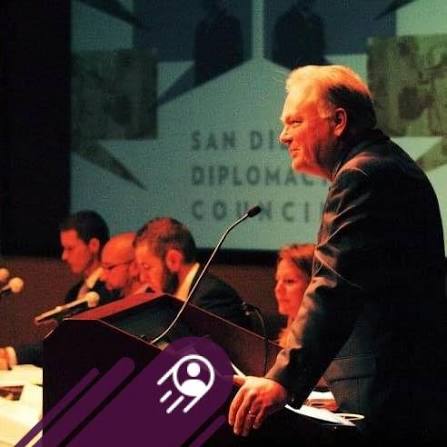
Today, his attention is focused on an Oxford-based study-abroad experience in international relations. The intensive summer program brings university and community-college students – and other intellectually curious travelers – into daily seminars with British and American practitioners and experts.
Participants live and study in Oxford while exploring the places that shaped British intellectual and political life. The experience includes visits to London, Windsor, Cambridge and Bath, a River Thames cruise, and time inside institutions such as the Ashmolean Museum and Bodleian Library.
They walk through colleges seen on screen, enter pubs associated with writers such as J.R.R. Tolkien and C.S. Lewis, and spend their free weekends discovering London or traveling through Europe.
But this is not simply academic tourism.
Ron wants students to develop the judgment required to understand an unstable world.
International relations becomes different when studied in a place marked by centuries of ideas, conflicts, institutions and leaders. History is no longer confined to a textbook. It becomes architecture, geography, conversation and lived experience.
The 2026 program welcomed 16 students. It has the capacity for as many as 100.
Ron’s dream is to bring between 50 and 100 American university students to Oxford each summer, building a growing network of informed young citizens who understand that the rest of the world is neither distant nor irrelevant.
At a moment when algorithms reward certainty, division and instant reaction, Ron is fighting for something more demanding: context.
He wants young people to ask better questions.
To listen before judging.
To recognize propaganda.
To understand competing interests.
To meet people whose histories are different from their own.
And to learn that diplomacy is not weakness. It is the discipline required to prevent disagreements from becoming disasters.
LEGENDARY | 08
THE LEGENDARY EDITION RONALD BEE
The Education the World Cannot Afford to Lose
Ron Bee’s story began with a father who survived a war.
But it has become a story about how humanity might survive itself.
His life connects a musician inside a Sherman tank, a seven-year-old greeting President Kennedy, a young man meeting Jimmy Carter, a scholar arriving in a bomb-damaged Bologna railway station, an analyst briefing Hans Blix, an expert studying nuclear crises at the Pentagon, an American touching the Berlin Wall, and a teacher asking students to see beyond their own borders.
These are not disconnected adventures.
They are chapters in one lifelong pursuit: understanding how history is made – and preparing others to make it differently.
Ron has seen the machinery of conflict from inside institutions. He has studied the moments when nations moved dangerously close to catastrophe. He has watched walls divide people and then watched those walls fall. He has helped students from countries shaped by conflict sit together and discover that the person across the table is not an enemy, but a human being with a story.
His work reminds us that peace is not passive.
It must be studied, practiced, negotiated and taught.
The next generation will inherit nuclear weapons, artificial intelligence, climate instability, disinformation, economic competition and political systems increasingly vulnerable to division. They will need more than ambition to lead through it.
They will need perspective.
They will need history.
They will need the capacity to enter complexity without immediately searching for an enemy.
And perhaps they will need what Ron Bee has been offering throughout his life: an invitation to leave the familiar, enter the world, and learn how to understand it before attempting to change it.
Some people become legendary by standing at the center of the story. Others do it quietly – by preparing the people who will write the next one. Ronald Bee belongs to the second kind.
LEGENDARY | 09
THE LEGENDARY EDITION RONALD BEE
A LIFE DEVOTED TO UNDERSTANDING THE WORLD DISCOVER
RONALD BEE
Continue exploring Ron’s work in diplomacy, education, international relations and the Oxford Study Abroad Programme.
Email: beehive.rb@gmail.com
WhatsApp: +1 858 354 6327
His website also lists info@learnthroughtravel.com and confirms that he directs Learn Through Travel, promoting study abroad at Oxford.
Full links so I can add to the article, please don’t give me just like that.
Website: https://learnthroughtravel.com/
LinkedIn: https://www.linkedin.com/in/ron-bee-8941a6a/
Facebook: https://www.facebook.com/ronald.bee.31/
YouTube: https://www.youtube.com/watch?v=KzRh_MK5TvQ&t=90s
Public email: info@learnthroughtravel.com
